


When Arianna Lint was a child growing up in a middle-class family in the coastal city of Chimbote, Peru, years before she transitioned, she loved watching stunning, elegant women compete in beauty pageants on TV. Her idol was the trailblazing Brazilian transgender actress and model Roberta Close, who in the 1980s and ’90s was often called the most beautiful woman in Brazil.
“It was my dream to move to the United States someday so I could compete in pageants,” says Lint.
She did ultimately move to the United States, in 2000, but fate had something else in store for her. After years of making a living as a sex worker, she was diagnosed with HIV in 2006. Soon thereafter, she embarked on a journey of advocacy and peer education that led to her founding Arianna’s Center in 2015. It’s the first service agency in Florida to focus on trans women of color.
Coming full circle: Lint is the CEO of Miss Trans Star International, a pageant for trans women from around the world to be held in December in Puerto Rico. Funded by HIV drugmaker Gilead Sciences, the grand finale will be preceded by three days of workshops about HIV prevention and care.
“People think beauty pageants are superficial,” Lint says, “but I use them as a platform to educate and empower people.” That was also her purpose when she appeared on the cover of a recent health-focused issue of People en Español looking both stylish and stern alongside the cover line “I Beat the HIV Stigma.”

Arianna LintSonya Revell
That combination of glamour and seriousness defines the 52-year-old Lint. Even in an era when politicians like President Donald Trump and others are demonizing trans people for political points, Lint holds fast to the idea that kindness, charisma and that good old immigrant work ethic can change minds and hearts, scoring lifesaving resources for her community.
On top of all her other responsibilities, she’s about to earn her master’s degree in education and community work. “In this tough social and political climate,” she says, “my major tool to fight back is to be educated.”
On a weekday in late June, Lint was in the cozy home she recently—and proudly—bought in Ft. Lauderdale, where she lives with her also newly acquired French bulldog, Pelón. She was in the middle of a busy week. She had recently received notice that the federal Health Resources and Services Administration (HRSA) would not renew a grant that for the past three years has paid the rent for Arianna’s Center’s two-week emergency transitional shelter for trans women with HIV just out of prison.
“It was an important program because we helped them stay undetectable,” she says. Lint is seeking alternative funding sources to reopen the shelter.
The next day, she attended a meeting as a member of the advisory board of the trans-inclusive PURPOSE 2 study for Yeztugo (lenacapavir), Gilead’s new twice-yearly HIV prevention drug.
Then there’s the daily work of serving Arianna’s Center’s more than 800 clients between South Florida and Puerto Rico, where she opened a site in 2019. “We’re the first resource for Spanish-speaking trans individuals in Florida,” she says. Earlier in the week, she had personally driven a client, as she often does, to a doctor’s appointment in Orlando, three hours from Ft. Lauderdale.
“Typically, people call me because they know me from social media,” she says. “They may tell me they need a place to live, but they’re HIV positive and don’t receive services, so it’s important for me to get them into HIV care to stabilize their health.”
Recently, she says, some clients have been calling her in dismay after losing their jobs. The Trump administration’s detention and deportation crackdown has caused many employers, scared of federal punishment, to either let go of or refuse to hire undocumented immigrants. One client called to say she had lost her job-linked health insurance, so Lint told her about a clinic that serves undocumented people.
Arianna’s Center also offers money and other help for trans clients to register their name change with Broward or Miami-Dade counties, the governments of which serve large populations of LGBTQ people and are friendlier toward trans folks than the state and federal ones.
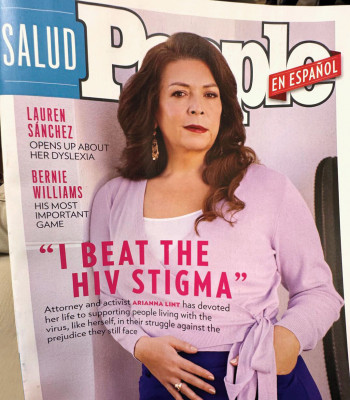
Arianna Lint on the cover of People en Español Salud (2025)
Due to funding constraints, Lint has had to lay off some staff. As a result, the center is now run only by her, her part-time assistant, her coordinator in Puerto Rico and both a volunteer executive director and development director. The center’s funding comes primarily from roughly $100,000 grants each from Gilead and ViiV Healthcare, a grant from Borealis Philanthropy and a few other grants under $100,000. Its operating budget is currently $200,000, she says, down from $500,000 last year.
“That reflects what we lost from HRSA,” she says. Additionally, the center just lost its contract with Florida’s health department. “They’re not going to renew any grants that serve trans people,” she says.
The center’s current setbacks notwithstanding, Lint’s journey from Peru to the present has been remarkable. As a child, she says, she knew she was trans from an early age but had to hide her identity. She majored in law and political science at Peru’s prestigious University of San Martín de Porres, where once, while presenting a legal case before a class, she recalls, the professor interrupted her. “He says, ‘In Peru, there are no faggot lawyers.’ I replied, ‘Well, there’s going to be one now,’ and I continued with my discussion.”
“I was educated to be a president or minister of my country,” Lint says. Nonetheless, once she graduated in 1996, she had to face the fact that Peru was not the best place to launch a career as an openly trans person. “I wanted to go to the United States because it’s the country of opportunity,” she says. “If you work hard in this country, you have the opportunity to make your dreams come true.”
However, once Lint arrived in the United States in 2000, she ended up living among other Peruvian trans women in New Jersey, just outside New York City, doing sex work like the rest of them. She attended her first New York City Pride March. “That’s when I fell in love with the LGBTQ community.” But at that time, there were nearly no resources for her and her trans sisters. “I saw many of them die of HIV,” she says.
After 9/11, Lint moved to Orlando to work for her brother’s cleaning company. She says both of her straight brothers, one of whom is now back in Peru caring for their mother, love and accept her, as do their families.
Now presenting as trans, she remembered what a friend in Peru had told her: that her Peruvian diplomas would not help her get far in the United States, where she should concentrate on making money to return to Peru and become a lawyer.
Then in 2006 came news that she wasn’t expecting: She tested HIV positive. Knowing next to nothing about HIV medications at the time, she resigned herself to dying eventually. “But I wanted to have a decent death,” she says, so she began receiving services at Orlando’s department of health. A staffer there named Gina—her best friend to this day—told her: “You have a law degree. We need people like you helping us [in the local fight against HIV].” A volunteer position at the health department as a peer educator led to a paid position. “I felt great,” she says. “You have to remember that for many trans individuals, our first real job is in the HIV field.” She also started taking HIV meds.

Arianna LintSonya Revell
A transformative moment occurred in 2008, when she found herself sitting, alone and timid, at an HIV training led by longtime advocate Linda Scruggs, a cisgender Black woman living with HIV. When Scruggs learned that Lint was trans, she said to her, in Lint’s words, “Come join us. We’re all women over here, like you. And with your history and your life, you can help change the lives of other people living with HIV.”
Lint cries as she recounts this turning point. Scruggs, a founding member of Positive Women’s Network–USA, remembers the moment as well: “Arianna didn’t realize she had power,” she says. “But I could see that she was ready and hungry to help her community and wanted to figure it out. So I told her, ‘We need a voice for Latina women.’” Scruggs helped convince the Ryan White Part D program in Orlando to hire Lint.
In short order, Lint was earning scholarships to attend the U.S. Conference on HIV/AIDS. Then SunServe, a local mental health nonprofit for LGBTQ people, asked her to develop the group’s first program for trans people.
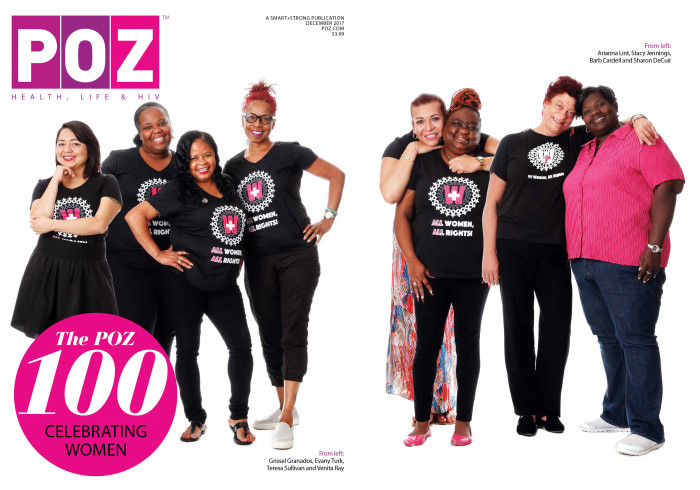
Arianna Lint on the cover of POZ (2017)
Eventually, says Lint, “my entrepreneurial side started asking, Why can’t I have my own organization?” She summoned one of her favorite Spanish words, fantasiosa—a fantasist—and paid a lawyer to form a corporation, starting Arianna’s Center with only about $5,000 of her own savings. The first two years were lean. She served clients out of her own rented home, which she then lost, briefly becoming homeless.
Then she received her first grant from the Trans Justice Project. Then another from Borealis. Then her first big one, $18,000, from AIDS United’s Transgender Leadership Initiative. A $75,000 grant from Gilead allowed her to obtain a small office.
Among her accomplishments that first year, Lint says she’s proudest of setting up HIV testing—but also of the name-change services she started, paying the $650 fee for clients to do so. “We got 45 names changed that year, and at this point, it’s up to 2,500,” she says proudly.
Again, with the federal crackdown on both immigrants and trans people, these aren’t easy times for Arianna’s Center. “Many of my clients right now are afraid they’ll get a criminal record for doing sex work or having to drive with no license,” she says.
If anyone is likely to continue using their triple threats of smarts, charm and heart to provide as much as she can for her community, it’s Lint. Wilton Manors Vice Mayor/City Commissioner Chris Caputo says he remembers being at a meeting with Lint when he first took office five years ago. “I didn’t know much about trans people and said something stupid like, ‘Why can’t trans people just…,’” he recalls. “But when others in the room attacked me, Arianna treated me with grace and started a dialogue with me. She’s always taken the high road.”
Tony Lima shares that sentiment. He helped Lint secure funding and find office space for Arianna’s Center before becoming CEO of SunServe. “Arianna’s a fighter and a really strong example of what trans resilience looks like,” he says. “If something doesn’t work for her, she’ll pivot—but she won’t stop.”
As part of the Deep South Coalition, Lint works to help create data to show how HIV impacts trans folks in the region. She has also long supported and advised other trans-led or -serving groups in the South. Tania Jimenez, a trans woman who leads Asheboro Latinx Services in rural North Carolina, says that when she started the group in 2022, Lint visited and gifted the group $1,000. “I really admire how she works to fight the stigma of HIV in the Latinx community,” says Jimenez.
As for Lint herself, she’s determined to remain positive during challenging times. “This current political situation sometimes makes us feel unstable,” she says, “but I prefer to think about what the United States has always promoted, which is that if you work hard and live healthy, you can do amazing things.”
Her life may be far from the one she dreamed of, when HIV and AIDS were only just emerging in a land far from her country of origin, but it’s one that she’s proud of because it lets her put her extraordinary intellectual and emotional talents to use for a community she loves.
What would Lint say to the glamour-loving child she used to be? She pauses before answering: “I’d say, ‘I think we did it. We’ve affected our community in a good way.’” Then, her eyes sparkling, she adds: “And we’re on the covers of magazines!”




Comments
Comments