

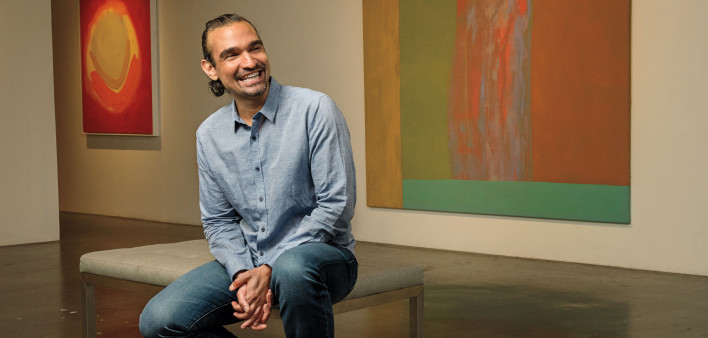
In 2016, Javier Muñoz, now 49, famously succeeded Lin-Manuel Miranda (LMM) in the title role of Broadway’s megasmash Hamilton. (He was called “the sexy Hamilton”!) He also succeeded LMM in LMM’s earlier Broadway show In the Heights. But aside from his talent, Muñoz has long been open about his HIV status and, in recent months, has been working hard with the group PrEP4All on their campaign to save domestic HIV funding (the Ryan White CARE Act, CDC prevention initiatives and more) in the face of a MAGA-led Congress that has signaled drastic cutbacks.
In this surprisingly frank interview with longtime POZ writer Tim Murphy, conducted for his Caftan Chronicles series featuring well-known gay men middle-age and older, Muñoz found a quiet nook in Central Park where he chatted for more than two hours. He was unflinchingly honest—first about the hell that a stalker has put him through in recent years, and then about working through childhood sexual abuse through intensive therapy. Muñoz will appear in the new, likely Broadway-bound musical Wonder this winter at A.R.T. in Cambridge, Mass., and is also in a new film called Brownsville Bred.
Javier, thanks so much for talking!
Sure. I’m in Sheep’s Meadow [in Central Park] and I found a little hill that has a nice circumference of safety so I can talk openly. I’m lying on the grass and it’s perfect. I just moved in January to East Harlem but this summer I reconnected with a lot of the things I love to do, being not just concerned with output. So, I started coming to the park almost every day. I’ve come to this spot in Sheep’s Meadow a few times to enjoy the sunset.
I’m so grateful to you, Javier. As someone who’s written about HIV/AIDS since the nineties, even before my own diagnosis in 2001, I want to thank you for coming out with your HIV status before taking on the title role in Hamilton and also for what you’ve been doing recently with #SaveHIVFunding, because as we both know, this is a dire time. What’s the latest with the threatened funding cuts?
At this point, because we are still in shutdown [This interview took place on November 7, five days before the shutdown ended] and we really don’t have any hint of this ending soon, no. But right now, every single effort we can make makes a tremendous difference, because we have people listening because of the shutdown. This is a strong time to be advocating.
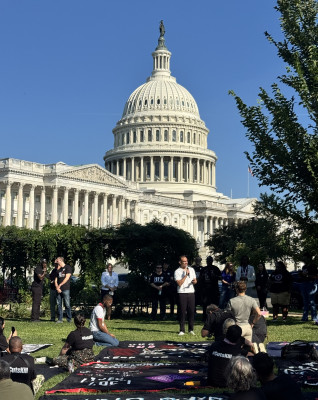
Javier Muñoz speaks at a #SaveHIVFunding rally at the U.S. Capitol in 2025Jennifer Morton
What’s an action step you want to give people?
People might be exhausted by this, but whether you’re in a blue or red state or whatever your rep is politically, call them, email them. And we have to let our Democratic lawmakers know we’re fighting for this.
These looming huge cuts to Medicaid mean that the 40% of people with HIV who rely on Medicaid could be pushed onto the AIDS Drug Assistance Program (ADAP), which could break ADAP.
People will have to turn to local community organizations and emergency rooms for their healthcare. It’s going to happen. It’s not a what-if. And this isn’t red or blue—it’s a human issue for anyone concerned for their healthcare.
You said on Instagram that your own healthcare was at stake. Can I ask how you get your healthcare?
Thank God right now I’ve put in enough working weeks to qualify for healthcare through the Actors’ Equity. Luckily I’ve had a beautiful year of employment, so that with every quarterly lookback, I have enough to sustain my healthcare, which will carry into next year. But if I have to work that hard to get enough work to maintain my healthcare, what is someone who’s just starting out doing?
For actors, that’s a precarious system. Has there ever been talk within Actors’ Equity to revise that?
Yes—years and years of conversation. It’s a tiered system and Equity has tried to adjust accordingly. We just had really strong contract negotiations. Right now, there certainly could be improvements, but when we do come to the table, I feel as though everyone there is always doing so with the clearest perspective of these times we’re living in and we have to be realistic. Thankfully because of Broadway Cares/Equity Fights AIDS (BCEFA), the Entertainment Community Fund (ECF) and our union, there are healthcare backup systems in place for us so that we don’t just fall off healthcare.
When you have to go off your actor’s insurance, is there something else to go on?
With ECF and BCEFA, whether you’re an usher, box office worker, a designer, working in the costume shop, you can find these resources to help when you know that you’re reaching the expiration date on your coverage. I would look at what BCEFA can help me afford as a COBRA plan until I go back on an Equity plan.
Tell me about your beautiful year work-wise, and what’s up now.
I kicked the year off with a bucket list dream of mine, to work at the Kennedy Center, before everything there changed [with Trump 2.0]. I got to do [the stage musical version of the TV hit show] Schmigadoon. Then I was at City Center with Wonderful Town.
No one ever lets me do a classic golden-age musical—but that’s my foundation! I worked with Anika Noni Rose, whom I adore. I’ve been doing a lot of developmental workshops. My film release came out this year.
I did a workshop of Galileo, which is Broadway-bound. And now I’m in rehearsals for the musical of Wonder, which is going to A.R.T. in Cambridge, Mass., this winter and hopefully will transfer to Broadway. It was a novel, then a film. It’s about a child with a disability going to school for the first time and what that brings out in their family, the other kids and the community at large. It’s some of the most beautiful music I’ve ever heard. The songwriters, Ian Axel and Chad King, are finally getting their due, and Sarah Ruhl is doing the book.
Very cool. So, you just moved to East Harlem. A high-rise? Describe your abode.
This is kind of an interesting situation. Yes, it’s a high-rise but it’s an intermediate apartment. I’ve been dealing with a stalker for three years and it led to a threat of violence at my last address on the West Side. I had to move quickly and break my lease, only to find out that my new building is home to the stalker’s family.
You’re kidding! That’s insane! A coincidence?
It’s beyond a Hollywood script, right? I’ve gotten the help of the NYPD, but stalker laws in New York are pretty loose so it’s hard to make things happen that you think should. The NYPD has been great actually. I’m safe, relatively speaking, but this has definitely been an ordeal.
I’m so sorry, Javier. Have they been told not to come near you, like a kind of restraining order?
Well, this is what’s so interesting about stalking laws in New York. I’m not married to him. I’ve never been in a relationship with him. I don’t know him or any of them. Because I have no familial attachment to him, I’m not allowed to put a restraining order on him. But the officers on patrol in my neighborhood know who he is and what he looks like. The last thing I would ever want is for something physical to happen.
But the sick irony is that if it did—
—then they could arrest him, and I could get the restraining order. But it’s the last thing I want to happen to me, obviously.
I’m so sorry, Javier. It sounds like fucking hell. How is your mental health around the whole thing?
It was not very good at the start. I was terrified of everything. I bought mace, legally, to have on my person. I was scared to walk around or take the train. But with the NYPD’s help, they’ve really made me feel so safe and been very kind to me. So now I feel like, “I got this—I can handle this.”
I very much wish you luck with it. It sounds so shitty. Do you live with a partner, a friend, a pet?
No, I live alone. My last relationship ended during lockdown. It was pretty painful, but it was the right thing to do, and I believe he’s very happy right now, and I’m very happy for him.
What’s a typical day like for you?
Okay, so if it’s an average day of rehearsal, I’m probably awake between 5AM and 6AM. I like to wake up with the sunrise and have a slow start, have my coffee and meditate and pray or read something inspirational, like Rumi. Then I have breakfast and work out at the gym, then get myself to rehearsal, which is usually 10am to 6pm Monday through Friday. I batch-cook so I bring my lunch with me.
What do you cook?
I’m a Trader Joe’s guy, so I get ground turkey and a multigrain medley in the frozen section, frozen vegetables and cook it all together and eat it in a bowl.
Haha, same. I joke that I basically make healthy dog food for myself—like sliced-up roasted chicken thighs, brown rice, farro, frozen spinach, a can of beans. I just mix the whole thing together like dog food and then throw soy sauce and chili crisp on it. I don’t even know what to call it but it’s cheap and healthy. What does an average theater workday look like?
It depends on where we are in the process. I’m playing the dad in Wonder so I’m not needed every day. Today I ended up not being called, which was really nice. I might have a three- or four-hour break in the middle of the day to go home or do errands. Sometimes I’m needed the whole day. It varies until we start doing stumble-throughs off-script, when I’m there the whole time, as I am once we start running the show and going into tech.
How many other original shows have you done?
Well, Hamilton and In the Heights. But there are lots of other shows that never got to Broadway that I was part of the creation of. I don’t really know what number original show this is. But I feel like my skill set really lends itself to new work. If the creatives are clear about what they want to accomplish, the story they want to tell—like with Hamilton, it was presenting history through the eyes of modern society—then I love being in the room to help guide that. That’s the most exciting thing. It’s a beautiful conversation where each of us, like the writer or composer, can only see or hear their work so far. It’s the role of the artist to say, “But this is what I see.”
You’re bringing layers onto a character.
Yes, it’s coloring in together. It’s so magical. There’s nothing better than that.
And when rehearsal finishes?
I tend to overextend myself so more often than not I’m heading to a benefit or other theater project or committee work with the various boards I’m on. Otherwise, I’ll go home. I call myself an old man, but in reality, eight shows a week for anyone is rigorous. I’ll do an early dinner and TV, salmon or chicken and veggies, and then be in bed by 9:30 or 10. I don’t have cable or Wifi, though.
How do you work on your laptop?
I just use my phone. I haven’t used my laptop in ages. And I’ve gone back to DVDs. There’s a Barnes & Noble I frequent because all the DVDs I want are on sale. I’m like the old man looking for eighties and nineties movies. This is—well, this is getting a little bit personal, but I’ve had such an amazing eight years of super healing. I’ve always been a big proponent of therapy. You don’t have to wait until something is wrong with you to go to therapy. I think everyone should have an hour a week to sit and focus on themselves. I’ve been in therapy since I was 15. I loved it. I think of it as taking my vitamins and eating right. It’s a part of health.
That’s so interesting. I was a problem teen, and my parents sent me to therapy. I felt shame about it. It was the mid-eighties and there was still a tang of—
Stigma, right?
Right. Like there must be something really wrong with you if you have to go to therapy. What was it at 15 that prompted you to go?
I was struggling with my sexuality. I was depressed and my parents were worried. I talked with my guidance counselor, who talked to my parents, and so they found me a therapist. It was really wonderful.
When did you come out to yourself, and to your parents?
I always knew. I had a boyfriend in kindergarten named Jacob. We shared milk and held hands at recess. I mean, I wasn’t comfortable with being gay as I got older because of social norms, but I definitely knew.
At 15, I didn’t have my place. There was nowhere I fit. And that was coming out in poor schoolwork. When I fell into therapy, it felt like a revelation to me, like, “There’s someone who can help me figure this out.”
So you talked openly about being gay with your therapist at 15?
I talked openly about how I felt. I didn’t really understand that yet. I didn’t have language for it.
And the therapist never said, “Do you think you might be gay?”
No. I think this therapist was really allowing me freedom—to discover, learn, ask questions, feel. And I needed that so badly.
They said, “Whatever you feel, it’s okay.”
Yes. I did end up coming out at 17.
I read that you went to Murrow High School in Brooklyn, which has yielded a lot of accomplished and famous people. Did you like it? It seems like it was very amenable to the arts and creativity.
Yes and no. It was structured to give you a lot of freedom and we had teachers who really guided us into discovering in our own ways. To this day, one of my acting teachers from high school, Scott Martin, is in my life and comes to my shows. I wouldn’t have a career without him. Murrow was amazing. But I was a very, uh—I was always in trouble and being sent to the principal’s office.
Me too! In retrospect I understand it related to being closeted and angry and miserable. What do you think was the source of your trouble?
[laughs] I had strong opinions. I was not getting along with a teacher and really needed to pass this class and said to them, “You can’t talk to me that way.” In the assistant principal’s office, I said, “He has no right to talk to anyone that way! How dare he!” I had to be taught how to use my feelings of justice and fairness and not just yell at everyone.
How did you come out at 17?
I wasn’t timid about my attractions but the label “gay” just didn’t feel right at the time. I couldn’t find a place where I felt like I belonged.
Even with drama club, which people call support group for queer kids?
That was the only place that made sense. Because there were no constructs. Art is discovery, process, feel it and what does it turn into? That’s boundless.
Not to assume all your feelings of not-belonging related to sexuality, but by the early nineties at Murrow, there was no queer student group?
That didn’t exist at the time at all. But that wasn’t even all of it. I was looking for identity in every way. That word belonged to other people. I wanted to know who I was before someone put something on me.
You didn’t want to say, “I’m gay.”
That’s one thing, right? I can say that now because I understand who I am as an adult. Me as a teenager didn’t want to say one thing, because I wasn’t one thing. That was me figuring out where all the parts of me belonged, and I didn’t want to use one word. I was really just boundless and bouncing off the walls with energy and not able to focus that under any umbrella. Even when someone was like, “You’re Puerto Rican,” I’d say, “Yeah, and—”. At that age, I didn’t understand how to communicate and convey things. I would yell and scream a lot and was really angst-y, because I felt like it was all trying to bottle me in when I was trying to figure it out.
Did you have friends?
Tons. Beautiful friendships. I did officially come out as gay at 17, right before graduating. I came out to some friends, then to my brothers.
How was the reception overall?
Good. I never really dealt with people pushing back on me about that. I’ve never been able to uncover why this quality exists in me, but I’ve always had a confidence and comfort in my skin, even if I didn’t understand what my skin felt like, as a teenager.
You had an understanding that you had talent?
An understanding that I love art. Everybody has talent—and I don’t mean that facetiously. Has it been tapped? Have they studied, tried to create something with it? Exposed to mentors and teachers, so that it’s something you can do something with in your life. I was always looking for teachers and people to help me figure things out.
Was there a point where you became more regulated in your behavior?
Yes, but it happened over years. Different teachers and mentors gave me incredible lessons. Elly Stone, who was a staple in musical theater along with her husband and was one of the original cast members of Jacques Brel Is Alive and Well and Living in Paris, was my first voice teacher and she took this version of me at 17 or 18 that was a mess of a kid.
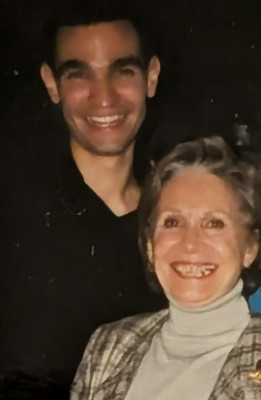
Javier Muñoz and Elly StoneCourtesy of Javier Muñoz
I mean, sure I was already working professionally, but I had no idea what it meant to be a professional, an artist. I had this thick Brooklyn accent. I couldn’t afford lessons, so she let me work as her personal assistant on weekends and during lunch breaks, she’d tell me stories about her career. I learned so much from her. She took this inner-city kid with his accent who was rough in all ways and said, “I’m gonna give you all the skills I can, because you’re a minority in this business, and it’s not going to be fair to you.”
Wow.
When I auditioned for NYU, she said, “They’re gonna gobble you up. You’re gonna make the program. But let’s get you ready so you can tackle anything they give you.” And she did. She trained me in Shakespeare and Chekhov, and with all versions of music. This is why golden-age musicals are my thing. She had me singing classical pieces in German. She gave me everything she could because she wanted me to be able to say “yes” to every opportunity that came my way.
What a fucking angel in your life, huh?
Yes! She passed away during lockdown unfortunately. But I still use the foundations she gave me, and not just in my art but in my life. She understood that I was this burning ball of fire, and she could sit with me and help me hone it. Because of her, I could walk into conversations and disagree and not scream at someone. I could voice my opinion and receive someone else’s and have a healthy debate.
What was the NYU experience like for you? I think of it as a rich kid’s school.
I transferred there from Brooklyn College and put myself through working three jobs. I got scholarship and financial aid, but I was paying for books, transportation, food, my dance clothes. I loved the experience. People I met there are still in my life who I create with. I was craving challenge and teachers to push me hard, and they did.
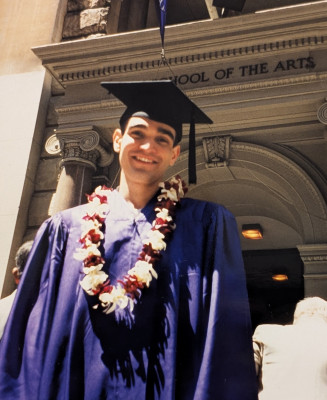
Javier Muñoz at his NYU graduationCourtesy of Javier Muñoz
Was there a point where you said, “I’m going to do this for a living”?
Freshman year in high school. I was there for astrophysics but didn’t want to do it. I had friends in the theater program. I lived in Canarsie at the time. This was the nineties—public transit was not safe. I got jumped a few times on my way home. I’d stay after school doing homework in the library and then meet my theater friends and go home with them, sometimes in a ride from their parents. Usually, I waited for them in the theater lobby, but one day I decided to wait in the theater. They were in tech for Annie, Get Your Gun. I sat quietly in the back and was like, “Why am I not doing this?” I auditioned for the next musical, which was The King and I. I got cast as an Amazon guard with no lines or songs, but I knew it was exactly what I should be doing in my life. And that was it. And my family was not happy about it.
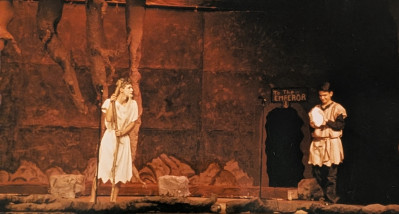
Javier Muñoz performs in a student-written musical at Edward R. Murrow High SchoolCourtesy of Javier Muñoz
Can you talk about your mom and dad?
I have good moments with my parents and brothers. I am not close with my extended family. I firmly believe that there are ways families should treat one another, and they don’t, and never did. I kept my distance from them, and I still do. But I had good times with my parents and my brother. But I didn’t realize until 2018, because of my therapy, there were just aspects to my behavior that I didn’t know how to explain. “Why would I choose this instead of this?” “Why would I think this?” These little spaces in my behavior that I just can’t wrap my brain around.
Can you give me an example?
Mmm—not really. It’s better if I just give you the whole blanket. But aspects to my day to day where I would choose things that weren’t necessarily what I wanted, and I couldn’t explain why.
You mean like drugs?
No. Just daily thoughts. “Why am I afraid of this person?” “Why do I feel so awkward in this moment?” Things not consistent with my personality. When I brought this up with my therapist, we really started talking about—getting nitty-gritty into, like, maybe we should start looking at things in your childhood that may have been really painful. Let’s really go back and start pulling things apart. And what it ended up being was me finally having these repressed memories slowly coming up and surfacing. We were going very slowly into trauma therapy, allowing me to remember things I had buried. That discovery led to me needing to put great distance between myself and my parents and my brothers.
I think in an interview you did, you talked about childhood sexual abuse. Is that what you’re talking about?
Yes.
Okay. Can you say by whom?
I don’t want to say that. But there ended up being far more parts of my childhood that I had not remembered that I needed to reconcile. Between 2018 and this year, I really went in deep—deep, deep, deep—to uncover all this, with PTSD therapy, EMDR. I was open to it, and it’s all helped. And it’s helped me truly understand why as a teenager I was so angry, volatile, full of fire and rageful at certain things, conversations, people, moments. So defensive and quick to anger.
What were the things that would trigger you as an adolescent?
I can barely remember. Just types of people and situations. There was a consistent rage in me that I didn’t understand when it came out. So finally in 2018, I finally broke through.
I’m not asking for details about who did it or what happened. I’m more interested in, what was the nature of the breakthrough? Was it just that the memories surfaced, or—
I was actually remembering moments in my life that I’d never remembered before, where my brain and body had protected me from them. I swear by therapy. I think we all need a place and a time and a way to just be concerned with ourselves and not anything else.
Can I ask you a devil’s advocate question? You’re certain they were real memories?
Yes.
And when they first surfaced, did you feel—terror? Rage? Disorientation?
It was fear. I just didn’t quite understand it, and I called my therapist immediately and we started talking through things and got beautifully busy with EMDR and PTSD therapy, which are both incredible things. Things in life can make me feel like I’m not in the driver’s seat, and I need moments to breathe, pause, figure things out, so it feels like I’m taking the reins. The scientist in me can break it down into atoms so I can see what it is. These therapies helped me understand these memories that were coming up were things I’d always suspected. I could finally figure these things out, and here we are. It’s been a beautiful journey of healing. This year, I finally sat down with my parents and talked things out.
You talked about the very issue that you’re telling me about?
Yes. We really came to a beautiful understanding where they’re back in my life. It’s not wrapped in a bow. But it’s a deep, deep holistic complete healing to be able to sit with my parents and have them in my life again. It’s not the same. It can never be like nothing happened. But it is a new starting point. It’s been a journey and a half of real work to get here. But this is where I’ve always wanted to be. When I tested positive for HIV [in 2002, while living in San Francisco], I was in a relationship and he was the only person I’d been with. I’d already buried the love of my life, who died in my arms at St. Vincent’s of complications from AIDS. I’d remained HIV-negative with him, so I was not someone unsafe to share your status with. I’d spoken openly about all the people I’d lost, all my fundraising and activism. The fact that in that relationship, he still felt that he could not tell me—
He withheld it from you.
Yes. And I became positive.
What do you think his thinking was?
I’m actually going to get there. The stigma was so great. That’s the power of stigma. People can call it whatever they want. If they want to jump to conclusions about his choices and behaviors, that says more about the person jumping to conclusions than anything in reality. The reality is stigma. Anyone who wants to come to conclusions can come find me and have that conversation with me, and they will regret it because I will put them in their place. It’s never about anything else but the power of stigma.
You don’t bear any anger toward him?
Well, this is the point of my telling this story. A year went by. I left San Francisco and moved back to New York city, then went to Los Angeles for a film. When I had a day off, I went to San Francisco and found him. And I forgave him.
Did he know you’d become positive from him?
Yes, he did. I bring this up to say, in me is the ability to forgive. So, when all these repressed memories were coming up in 2018, I was determined to heal. I wanted peace. I wanted my heart and mind to know healing. And it would take as long as it took. But I knew that I had it in me to eventually find it in me to forgive my parents. And eight years later, I got to sit with them and do that.
Wow. Did they ask for your forgiveness?
No, no, no.
Were you the one who said, “Hey can we have a conversation?”
Yes. They were very receptive.
They didn’t recoil into denial or anger, like, “You’re crazy”?
Not at all. It was a beautiful, adult conversation.
But what you told them you’d resurfaced, they acknowledged?
We had a conversation where I was able to tell them that I didn’t need anything from them, because I had healed. I’d done so much work that no matter what they said, I was going to walk out of that apartment just fine. It took eight years of dedicated work, to want to love myself so completely. And they were in a place to just be there with me. And that’s where they are. The conversations I have with them now are just unbelievable.
How so? They have a greater depth?
Yeah. There’s nothing hidden. Yes, they’re my parents but they’re also just people who had a whole life that happened before I was born that they have to live with and heal from.
It sounds like they were implicated in some way, yet you say they didn’t apologize or ask for forgiveness. Does that bother you?
If I may, the phrasing of that question means that I may not be explaining this well. Because it was not about blame. That’s not a conversation to have, where you point fingers and need something in return. That’s need. I didn’t need that. We both already know what happened. It’s not about, “You did this, now say you’re sorry.”
Okay. How did these therapies help you heal? You said earlier they made you able to break your feelings and memories down to the atom level. Is that how you’d best explain it?
For the way my brain works, that’s how I can best explain it, to break things down into parts. The best way I can explain it is like anything: I think when someone is diagnosed with HIV, there’s shame involved. When someone is challenging an addiction, there’s shame involved. Or confessing to a partner or loved one that they’ve done something wrong. There’s aspects to everything that involve self-healing and self-forgiveness. These therapies not only allowed me to understand what, when and how it happened, but also to just be human and feel my way through it so that I could forgive myself.
For what? Getting HIV?
I just mean in general. If I were married and got divorced, I would blame myself for it and have to heal it. No matter what the thing is, we all have a process of self-healing that involves forgiving ourselves. The therapies gave me the ability to forgive and love myself, and say, “I was only a kid. What was I supposed to do?”
And you’re still in therapy, right?
I plan to be with a therapist until the day I die. It is the greatest thing in the world. You don’t have to be someone who has any major thing in your life, even though we all have something. It’s about giving yourself the love, time and care you need to grow and heal. To see aspects of your life that you never were able to see before.
Absolutely. Self-understanding. In a way, we are shadows to ourselves. We can’t see ourselves fully. But being able to see yourself changes the way you operate in the world.
Exactly. This entire year I’ve felt in a place of such bounty and abundance and joy and love and laughter and light and success and beauty and creativity. This year has manifested so much, and it’s a direct result of so much beautiful healing and growth, and having conversations that make people uncomfortable, but why shouldn’t we be talking about these beautiful processes and feelings and journeys when we’re all feeling some degree of it.
Yeah. I was wondering how—um, you’ve said “I’ve healed.” To my knowledge, I was not sexually abused—well, I was basically raped in college, to be honest.
I’m sorry.
Let me think about what I’m trying to say. I’ve been in a great deal of therapy. But I’ve also sort of accepted that—okay, let’s take shame. I’ve come to this realization that rather than this idea that I have to get past shame—I mean, I’m a writer, and you’re an artist, so you think about the way that you can use different things that you feel. Let’s say shame around being gay and gay sex.
Oh, sure. Yeah.
Rather than feeling like I have to fully get past it, I feel like I’ve almost made friends or peace with the idea that I will always feel some shame around gay sex, and that it can coexist with the pleasure of sex, and that in some way, the shame mixed in there can even be hot. Does that make sense?
Uh, it does.
I no longer think that I’m not complete until I’ve 100 percent gotten past it. At this point in my life, it’s woven into my DNA. I’ve made peace with it.
Yes, I think I can agree with that to a point. I love that—it’s realistic. I think that’s what I’m kind of getting at when I say that I’ve done all this work to heal. Like losing Michael.
That’s the love of your life who died of AIDS?
AIDS-related causes. I was twenty when I lost him, I was at NYU. It never heals. “Oh, Michael. I don’t feel anything about that anymore.” Of course I do! I miss him to this day. There are songs that can make me cry when I hear them because I ache missing him. That’s not healed. But it’s peace. Acceptance. So, to your point, I think when it comes to anything like shame or pain or trauma, there is a degree to which it will always just be there. But it’s a part of me.
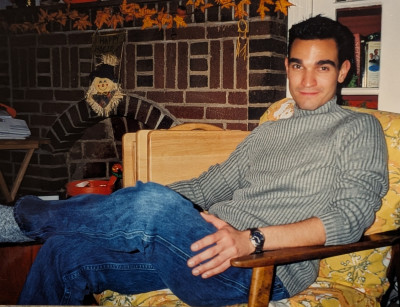
Javier Muñoz in his early twentiesCourtesy of Javier Muñoz
Javier, you’ve been incredibly generous with me, and I’m really struck and moved with how open you’re being. It gives something to the readers.
I hope so. That’s why I do this.
You make me want to be in a conversation with you rather than just extract deep secrets from you. Hence why I try to be candid too. Extending from what I was saying about shame and guilt— did you grow up Catholic?
[laughs] Oh, yes. Very Catholic.
Well, same. Shame and guilt overlap to me. The only thing I’ve wondered about is, is the residue of that—I mean, I’ve had three relationships, all about five or six years. They’ve all ended. Even though I’m very happy being single right now, very happy with friends and family, I sometimes wonder when I see couples who’ve been together forever, “Have I not done the work to love and be loved as deeply as I could?” Do you ever have that thought?
I think everybody has that thought. But I also look back at my choices and—listen, I’m not going to say about my exes, “Oh, they’re losers.” Every one of them was a good person. But I realize that I also was making choices from places that I didn’t even know existed. I can look back and say, “I let this person into my life because I had this thing I felt but I didn’t know why.” And it made sense after I discovered, “Oh, this happened to me. So of course I chose this guy.” We choose what’s familiar.
Absolutely. Whether it’s good for us or not.
As these memories came back to me and I could work through them, I was able to identify that I was choosing partners to repeat a familiar pattern. I think I have a funny relationship with the idea of relationships. I think they’re wonderful and magical, and I also think they’re not always necessary.
Same. A big realization I think I’ve had in recent years is that you can get what you need from a wonderful network of friends as much as from any one person.
Yes! I think that’s so beautiful. Sometimes I’m sitting across from a friend having a coffee and think, “You are so incredible. I am so lucky that you’re in my life.” That’s magic to me.
Even with good friends, you don’t put the kind of pressure on that friendship that you put on a relationship, and I think it gives it more room to breathe and makes it more sustainable.
I agree completely. But in the same breath, if Michael were still alive, I hope we would’ve spent all these years together. With him, I still play the what-if game, if we’d had a family together. But who knows?
That’s a very young age to lose someone.
He really died in my arms at St. Vincent’s. November 1, 1996. I’d spent Halloween with friends and woke up the next day, and as soon as my eyes open, I thought, “I have to go to the hospital to see him today.” And I cut school. His sister and cousin were there and went downstairs briefly. I was alone with him and put my head on his chest and listened to him breathe and said what I had to say to him. And then he was gone.
And that was the very same year things started turning around for a lot of people, too, because of new med combinations.
Correct, but it was too late for him.
How did you two meet?
On the train.
So sexy! So New York!
I was coming into the city on the L train from Canarsie and he got on at Broadway Junction and sat down across from me, and I was like, “Hello.” I was not letting him out of my sight.
That is so hot. Javier, you’ve shared so much with me. How do you feel? Did I emotionally drain you?
No, not at all. The reason I came to the park was to be this open. I take great value in being open. I have learned from the moment I started living openly with my HIV status in 2005, I’ve realized what a difference it makes for other people to witness that. This is why it’s important for me to go through that therapy process and then be able to talk about it. I know what it means for anyone out there who might receive this story, and it might help them. And I may never meet them. But I know someone somewhere is going to gain something from it.
The Caftan Chronicles by Tim Murphy is a series of “deep talks with notable gay men ‘of a certain age’ about where we’ve been, who we are today and where we’re going.” Murphy is a long-time contributor of POZ and the author of the novels Christodora, Speech Team and Correspondents. He has also contributed to The New York Times, New York, The Nation and other publications.




Comments
Comments