

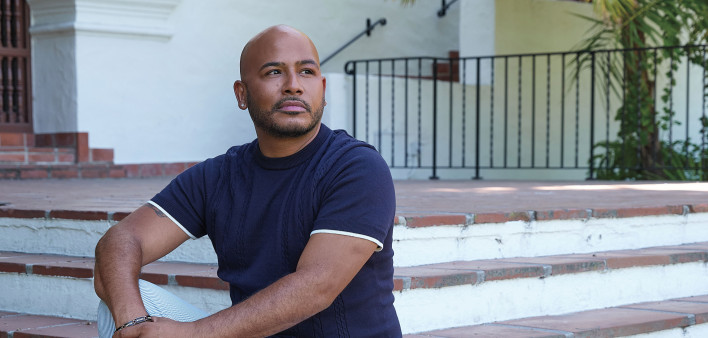
Julio Roman first confronted HIV and AIDS when he was 10 years old. That was 1993, the year his Aunt Naomi found her way to the home he shared with his mother and twin brother on the south side of Newark.
“She showed up in a hospital gown dying of AIDS,” Roman explains. “And my mom was her caretaker until she passed away in our home. Watching my mother care for her with dignity before there was really any support system—that shaped a lot of what I’ve become today.”
Roman’s mother, Rosario, also taught him the importance of safe spaces. His book, Out of Space: Creating Safe Spaces in Unlikely Places, focuses on the importance of safe spaces to combat the virus. That’s especially true in immigrant communities and for anyone closeted about their sexuality or HIV status.
Roman is currently the executive director of the Pacific Pride Foundation in Santa Barbara, California. He’s also the founder of Project WOW, a Newark-based AIDS service organization that recently celebrated its 25th anniversary.
“I was recruited [to California] specifically to build programming for our Indigenous and migrant community,” Roman says. “The Pacific Pride Foundation recruited me because of my experience in capacity building. Prior to coming here, I was vice president of the Latino Commission on AIDS, where I had a portfolio of 70 national Latino organizations whose HIV testing and prevention programs I helped build.”
That’s vital in places like Santa Barbara, which has a population that’s about 52% Latino. According to Roman, who calls himself “100% Puerto Rican,” noncitizens in the region remain especially vulnerable to the Trump administration’s anti-immigrant impulses.
Roman’s career as an activist kicked off shortly after his first HIV test.
“I was involved in a lot of risky sexual behavior,” Roman explains. “And at 16, I was tested by a trans Latina woman. Like many folks, I thought I was going to die. She really spoke life into me and empowered me that regardless of that result, it wasn’t going to be the end of me.”
Roman tested HIV negative that day and remains so.
“That’s when I knew that I wanted to do something important, like that trans Latina outreach worker was doing,” he says. “So at 16 [in 1999], a position became available for an outreach worker.”
Roman distributed condoms while canvassing strangers, an audacious form of outreach in an era when there was little guidance on how to talk to people about HIV.
“We were literally assessing folks based off the community building and conversations we could have with them out on the street,” Roman says. “Many times those conversations were great, and other times we were put in danger, unbeknownst to us, being young gay men asking people about [same-gender] sexual behavior.”
All these years later, Roman is an elder statesman in the battle against the virus, with a keen focus on protecting his fellow Latinos.
“The rate of HIV among Latinos is still a public health emergency,” Roman warns. “One in three Latino gay men are becoming positive. You look at our white gay counterparts, it’s like 1 in 15. We still have a lot of work to do.”



Comments
Comments