

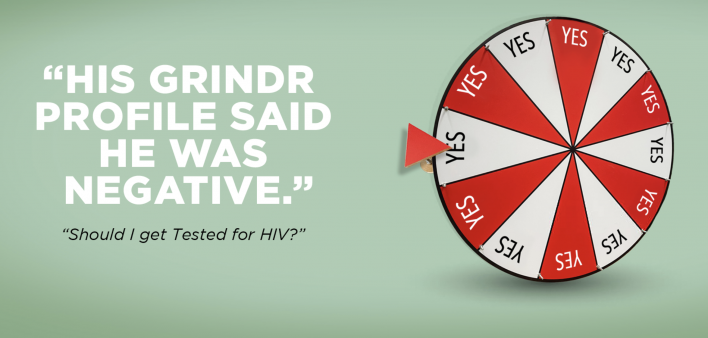
Pop quiz: If the following quotes described your situation, should you get tested for HIV?
- “We were kinda drunk.”
- “I only get down with women.”
- “His Grindr said he was negative.”
- “He said he was allergic to latex.”
Answers: Yes, yes, yes and yes! Get tested for HIV in each of these scenarios.
You may have seen these questions posed on social media posts. They’re part of a campaign for National Latinx AIDS Awareness Day (#NLAAD), which is observed every October 15. This year’s theme is “Should I get tested for HIV? Yes!”
View this post on Instagram
In addition to promoting HIV testing, the campaign offers more insights about HIV transmission and healthy sexual relationships. For example, some campaign ads note, “Keep in mind that not everyone knows or discloses their HIV status on dating apps. 14% of Hispanics living with HIV don’t know they have it.” Another one adds, “Alcohol and drugs can lower your inhibitions and lead you to have unprotected sex, increasing your risk of getting HIV.”
Launched in 2003 and spearheaded by the Latino Commission on AIDS (LCOA) and the Hispanic Federation, the awareness day draws attention to the HIV epidemic among Latinos, one of the few population groups in the United States experiencing an increase in HIV cases.
View this post on Instagram
Local HIV and Latino organizations and advocates amplify NLAAD to promote their services and raise awareness. “Recognizing National Latinx AIDS Awareness Day is an important reminder of the work we still have to do within our community to raise awareness of HIV, reduce stigma and promote HIV prevention,” said Oscar De La O, vice president and founding member and former president/CEO of Bienestar Human Services. “At Bienestar Human Services, we continue to focus on our community in Los Angeles and partner with committed organizations like ViiV Healthcare to address the unique challenges faced by the Latinx community who are impacted by HIV by providing citywide HIV testing and raising awareness of HIV prevention.”
“HIV doesn’t discriminate—it affects all types of people. But for complex reasons, ranging from stigma to medical mistrust, some groups in the U.S. are disproportionately affected by HIV,” said Randevyn Pierre, head of U.S. External Affairs at ViiV Healthcare, in a statement to POZ. "For example, among all racial/ethnic groups, the Latinx community has seen the greatest increase in new cases of HIV over the past five years. That is why this year’s National Latinx AIDS Awareness Day needs to be a wake-up call for the work that remains in the fight against HIV. At ViiV, we work with the Latinx community to educate about HIV prevention and treatment and to support organizations that are working to address HIV within the Latinx community. We believe that it will take all of us working together to end the HIV epidemic for all.”
“In 2025, NLAAD centers its efforts on HIV testing, recognizing it as a critical step in ending the epidemic,” write the awareness day organizers in a press statement. “An estimated 170,000 people in the United States are living with HIV and unaware of their status. This gap in diagnosis delays access to lifesaving treatment and increases the risk of unknowingly transmitting the virus. By promoting testing, NLAAD aims to raise awareness, reduce stigma and empower individuals to take control of their health.”
| El alerta a las comunidades hispanas: ¿Debería hacerme la prueba del VIH? ¡Sí! | #New York #SondeoRDNews #RD El movimiento Día Nacional Latino de Concientización sobre el Sida (NLAAD) fue creado en 2003 por la Comisión Latina sobre el Sida (Latino Aids) y la Federación Hispan
— Sondeo RD News (@sondeordnews.bsky.social) October 12, 2025 at 2:53 PM
[image or embed]
Judith Montenegro, director of Latinos in the South, added, “National Latino AIDS Awareness Day underscores the urgent need to address the structural barriers that keep Southern Latinx communities from equitable access to HIV prevention and care, Federal and state policies that restrict health care access and underfund prevention efforts only deepen these disparities. NLAAD is an opportunity to advocate for systemic change to ensure Latinx communities in the South have the resources and tools they need to access health care”
“This year, NLAAD is focusing on HIV testing because it’s the first and most important step in ending the epidemic,” said Luis Mares, director of community mobilization at the Latino Commission on AIDS. “There are still around 170,000 people in the U.S. living with HIV who don’t know it. If we don’t know our status, we can’t get the care we need or protect others. Testing opens the door to treatment, prevention and peace of mind—and that’s what we want for our communities,”
AIDSVu.org, an interactive site that creates maps and charts from HIV data, offers more details about the intersection of HIV and Latino communities. Writing about NLAAD 2025, AIDSVu notes:
Key Facts
- In 2023, there were 39,182 new HIV diagnoses in the U.S.
- Hispanic/Latinx people accounted for 32% of new HIV diagnoses, despite making up only about 19% of the U.S. population.
- Among Hispanic/Latinx individuals diagnosed with HIV (2022 data, most recent available by transmission category): 77% were attributed to male-to-male sexual contact; 16% to heterosexual contact
In 2023, HIV care continuum outcomes showed:
- 8% of newly diagnosed individuals were linked to care.
- 3% of people living with diagnosed HIV received care.
- 2% achieved viral suppression.
PrEP Use
- PrEP use is growing: Between 2022 and 2023, the number of PrEP users increased by 17% nationwide.
- In 2024, more than 591,000 people were using PrEP, with a national PrEP-to-Need Ratio (PnR) of 15.6 (about 16 PrEP users for every new HIV diagnosis).
PrEP Disparities persist
- Hispanic/Latinx people represented 31% of new HIV diagnoses but only 18% of PrEP users.
- Black people accounted for 39% of new diagnoses but just 14% of PrEP users.
- White people made up 24% of new diagnoses but 64% of PrEP users.
- Regional inequities: In 2024, the South accounted for 53% of new diagnoses but only 39% of PrEP users, with the lowest regional PrEP-to-need ratio (12).
Social Determinants of Health
HIV prevention and care outcomes in Hispanic/Latinx communities are shaped by broader social and structural factors, including:
- Access to health care: Lack of insurance, language barriers, and limited culturally competent care providers restrict access to prevention and treatment.
- Economic barriers: Higher rates of poverty, unstable housing and employment insecurity can disrupt consistent HIV care.
- Immigration and stigma: Fear of disclosing HIV status, immigration concerns and stigma around both HIV and sexual orientation can prevent individuals from seeking care.
- Geography: Many Hispanic/Latinx individuals live in the South, where HIV rates are highest and prevention resources are most limited.
National Latinx AIDS Awareness Day 2025 is a reminder that addressing HIV inequities requires sustained investment and culturally tailored strategies.
View this post on Instagram
For related news and inspiring stories in POZ and our sister publications, click #Latino. And be sure to check out the current issue of POZ. It includes the cover story “Staying Positive in Challenging Times,” which profiles transgender advocate Arianna Lint. Also in the issue is the feature “The Importance of AIDS in Modern Stories,” an interview with poet and writer Andrés N. Ordorica.
View this post on Instagram
And our recent POZ Focus highlights Latino men and HIV. The cover story, “Latinos Living With HIV Can Have Joy,” follows two men’s journey with HIV, family and U=U.
Click here to learn more about 2025 HIV and AIDS awareness days, and click here for a printable poster.
View this post on Instagram



Comments
Comments