

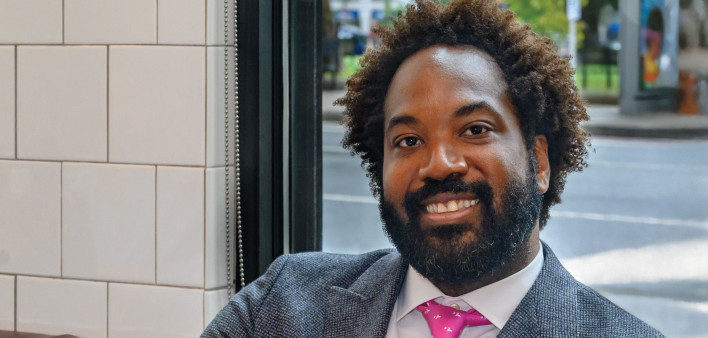
In July, after 10 years at AIDS United, Carl Baloney Jr. stepped into a new and very important role. He succeeded Jesse Milan Jr. as president and CEO of the HIV organization, becoming the second Black gay man to hold the post.
“What brought me to this work was knowing that I am the population that is most at risk for HIV and AIDS,” says 41-year-old Baloney, who is HIV negative and lives in Washington, DC. “It’s heartwarming to be in this position.”
Baloney first joined AIDS United in 2015 as director of government affairs. Previously, he was the group’s vice president for public affairs and chief policy officer. His job included leading strategic communication, public policy and advocacy efforts.
“From the policy perspective, we made sure to maintain strong relationships with policymakers on Capitol Hill and in the White House,” he says. “So that when there was an opportunity to engage on either a positive action or to push back against a negative action, we would be heard.”
Baloney played an important role in doubling the size of AIDS United’s Public Policy Council (PPC). The council now has over 60 member organizations. The council’s mission is to bring together HIV-focused groups from across the United States to advocate for people living with or vulnerable to HIV.
Now more than ever, local power is critical to positive change.
He also doubled the reach and capacity of AIDSWatch—the largest constituent-driven HIV federal advocacy event in the country.
“I didn’t double those events for numbers,” Baloney says. “I doubled it for impact and representation—better geographic, racial, ethnic, linguistic and gender identity representation.” Because, as Baloney notes, policymakers should ensure that everyone is included and heard.
As he looks to the future, Baloney wants to use both PPC and AIDSWatch to bring about important changes. He hopes to thread the needle for communities between federal and local advocacy and policy action.
“Now more than ever, local power is critical to positive change,” he says. “It’s certainly been critical to the negative changes that we’ve been experiencing.”
AIDS United had announced that Baloney would succeed Milan upon Milan’s retirement on July 1.
“Jesse and I upped how often we met,” Baloney says. “I started meeting with our finance team and board more regularly and communicating more directly with the staff.”
Baloney also took the lead on some speaking engagements and meetings.
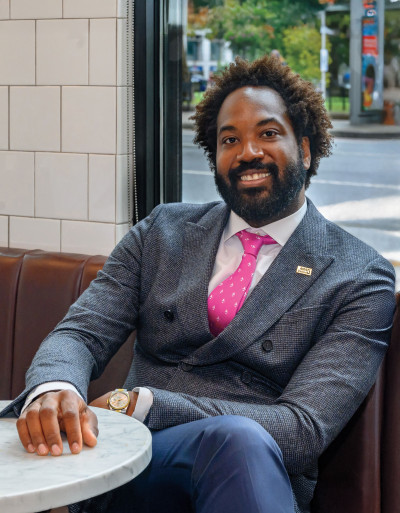
Carl Baloney Jr.Liz Roll
“It was really quite seamless,” he says. “I was really fortunate to have the trust of the board and to frankly have buy-in from the staff, who didn’t actually quite know what was going on yet but trusted me in those spaces.”
Six months into his position, Baloney faces the challenge of leading an HIV organization at a time when people living with HIV in the United States are afraid of rising stigma, a loss of access to affordable medication and cuts to essential HIV funding. But he remains undeterred.
“Our movement was built for this moment,” he says. “We’ve found ourselves in dire and devastating times before, and we were able to not only persevere but eventually really build something.”
It all starts with people living with HIV and those at risk being unashamed and unafraid to share their stories, Baloney explains.
“I believe, at my core, that the vast majority of policymakers come to DC to positively impact their communities, and they need to hear the stories of impact,” he says. “They need to know that you depend on Medicaid and SNAP [Supplemental Nutrition Assistance Program, also known as food stamps].”
As a millennial, Baloney might just be the right person to inspire AIDS United’s staff at this difficult time.
“Millennials sit at an interesting intersection,” he says. “We have some of the pragmatism of the older generations and then a little bit of the urgency of the generations beneath us. I think we’re a healthy mix open to different perspectives.”
“My generation is ready for this,” Baloney says. “We’ve built the requisite skills and invested in education and knowledge. It’s really critical that we have the opportunity to bring our voice to bear in these conversations and to utilize the lessons that we’ve learned from our mentors who came before us.”
Baloney hopes he can serve as an example to other young Black men no matter their field. He thinks fondly of the Black male peers and mentors who poured into him over the course of his career. It’s what he wants to do for others.
“I’m incredibly proud to be in a position to fight for what I believe in and hopefully bring others up with me,” he says. “There is enough room for all of us.”
Despite all the work that must be done, Baloney knows that advocates need a break.
“When you care, that can be really difficult, but you have to step back and realize this is a marathon, not a sprint,” he says. “I think people need to work together on stepping up and stepping back. Like, Hey, I’m going to do this for a while, and then I’m going to step back and take care of myself, and you step forward and continue that fight.”
Burnout is real in work like this. That’s why AIDS United staffers have unlimited vacation leave and are recommended to at least take a whole week off.
Baloney has a built-in off switch that lets him step away. He’s also a father to 5-year-old twins. “Parenting is hard, but not thinking about work because they want to go to the pool or the playground helps,” he says.
Baloney urges advocates never to lose sight of hope.
“The moment when things look their most bleak, those are also times when cultivating hope is most important,” he says. “I really would encourage advocates to celebrate their wins, no matter how small or seemingly fleeting.”




1 Comment
1 Comment