

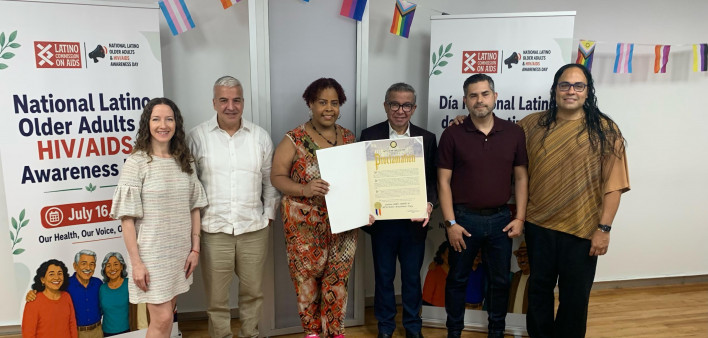
“When I think about aging with HIV, I don’t think about the virus. Honestly, I don’t do it,” said Luis Nava Molero, “I think more about faces. I think about friends who should be sitting here today but are no longer with us. Their absence reminds me that every day we are given is a gift, but at the same time it’s a responsibility.”
Molero, the director of aging initiatives for the Latino Commission on AIDS (LCOA), made these remarks as part of a press event to spotlight National Latino Older Adult and HIV/AIDS Awareness Day, held Thursday, July 16, at LCOA offices in Manhattan. The theme of the awareness day this year was “Our Health, Our Voice, Our Future.”
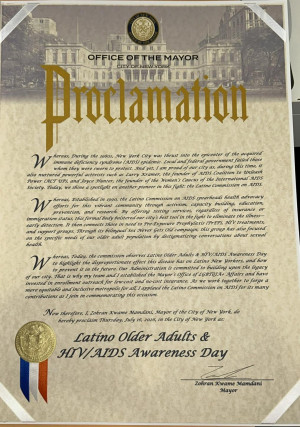
Marking the occasion and bearing the official seal of the New York City Mayor’s Office, a proclamation signed by Mayor Zohran Mamdani honored LCOA and officially declared July 16 as Latino Older Adult and HIV/AIDS Awareness Day in New York City.
The press conference was moderated by Leandro Rodriguez, LCOA’s vice president of programs. Molero was joined on the panel by Sarah L. Braunstein, PhD, MPH, assistant commissioner of the city’s Bureau of Hepatitis, HIV and Sexually Transmitted Infections at the Department of Health and Mental Hygiene; Chanel López, deputy director of LGBTQ affairs for the New York State Executive Chamber; Jesús Aguais, president of AID FOR AIDS International; Rafael Romero, peer health senior coordinator for Translatina Network; and, via video, Demetre Daskalakis, MD, MPH, chief medical officer at Callen-Lorde Community Health Center.
“At the Latino Commission on AIDS,” Rodriguez said, “we remain committed to advancing health equity through culturally and linguistically responsive services, reducing HIV-related stigma, promoting mental wellness, supporting healthy aging and advocating for systems that allow every person to thrive.” He went on to encourage continued commitment from every community partner, elected official, community advocate and healthcare professional to forge a future where every Latino adult can age with health, dignity and hope.
When it comes to HIV, the statistics on HIV among older people are surprising. The Centers for Disease Control and Prevention estimates that about half of people living with HIV are 50 or older. Latinos over 55 living with HIV make up about 20% of those cases. Moreover, about 20% of all the new HIV cases for people 55 and older in the United States were in the Latino community, with 6% of those people not aware of their status. Additionally, older Latinos living with HIV face compounded health issues, including accelerated aging and accentuated aging with comorbidities like cardiovascular disease and diabetes being at higher risk than people not living with the virus.
“As we grow older, many of us face new challenges,” Molero said. “Many of us have not only been dealing with HIV but also with cancer, hepatitis and you-name-any-other health condition. We learn to navigate doctor’s appointments, medications, fatigue and the uncertainty that times come with aging. There are days when our bodies remind us that time has passed. There are moments when we feel isolated or misunderstood, and yet we continue moving forward.”
Braunstein added to the conversation, reiterating challenges for Latinos aging with HIV. “Older adults may be managing multiple health conditions and medications while also experiencing housing or food insecurity, loneliness, social isolation and stigma related to both aging and HIV,” said Braunstein. “For many, those challenges are compounded by language barriers, immigration concerns and limited financial resources.”
She went on to add the importance of continuing to invest in education, prevention and treatment resources, while also acknowledging and addressing the gaps of need when it comes to strategically marginalized communities.
“We must continue to encourage HIV testing and ensure that everyone can access the prevention, treatment and support services they need,” said Braunstein, “And we must continue lifting up the voices and experiences of older Latinx adults with HIV by listening to them, and importantly, helping to share their stories.”
The importance of community and connection is paramount for people living with HIV, and Latinos are no exception. “Isolation and loneliness are two big problems with our Latine family,” said Rodriguez. “We [at LCOA] have begun initiating mentor programs, where older people with HIV can connect and mentor younger people.” Rodriguez continued to say that this not only helps foster community and battle isolation and loneliness, but it also gives the younger people hope. “They can see themselves in the future by witnessing their mentors,” he said.
National Latino Older Adults and HIV Awareness Day’s focus is to encourage older Latino adults to take charge of their health, get routine HIV testing, learn about HIV prevention, stay engaged in treatment, prioritize their mental health and speak up for their healthcare needs. However, it also reminds us that creating healthier communities takes all of us. By working together, we can help ensure Latino older adults have access to care that is equitable, culturally responsive, and age-inclusive, while still supporting healthy aging and quality of life.
“For many people, HIV is just a statistic, a diagnosis or a chapter in history,” Monero said. “For me and for so many others, HIV is more than that. It’s a lifetime. It is a journey that has shaped who we are, the people we have loved, the friends we have lost, and the resilience we have built along the way.”
Part of that resilience is not being afraid to ask for help and leaning on our community. “None of us should have to walk this journey alone,” said Monero, “that is why the Latino Commission is here, because no one should walk on this journey alone.”

Comments
Comments