

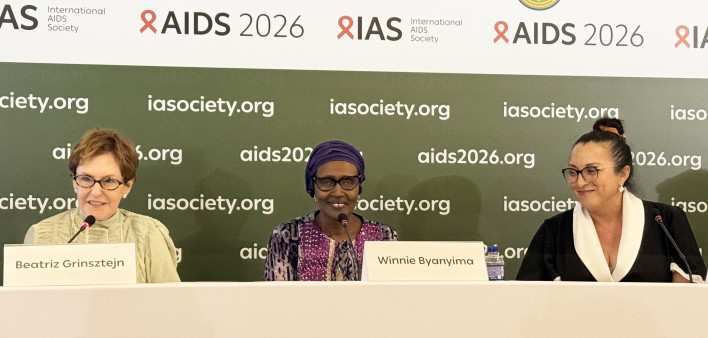
The 26th International AIDS Conference (AIDS 2026) opened Monday in Rio de Janeiro, with global leaders taking stock of a new reality spurred by the precipitous decline in funding for the HIV response worldwide.
The biennial conference, convened by the International AIDS Society, brings together thousands of policymakers, public health officials, clinicians, scientists, advocates and people living with HIV.
The Trump administration’s cuts have driven an unprecedented drop in funding from donor governments, putting decades of progress at risk, according to newly released reports.
“Never has donor funding fallen so far, so fast, and those most vulnerable are already paying the price,” IAS president and conference cochair Beatriz Grinsztejn, MD, PhD, said at the opening press briefing. “Donor countries are choosing to walk away while many high-burden countries remain shackled by debt they cannot escape.”
The decline in funding comes as an end to the global HIV epidemic is in sight thanks to highly effective antiretroviral drugs for treatment and prevention, including the new twice-yearly injectable PrEP option lenacapavir (Yeztugo). But these tools can only make a difference if they are accessible to those who need them most.
“This is one of the greatest public health achievements of our lifetime. But let’s be clear, progress is not the same as victory,” said UNAIDS executive director Winnie Byanyima. “Scientific breakthroughs alone will not end AIDS. Innovation without access is not innovation; it is injustice….Science has done its job. Now politics must do its job.”
New Reports
A set of new reports outline the grim reality.
According to a special report from UNAIDS, 1.2 million people acquired HIV and 570,000 people died from AIDS-related causes in 2025. Around 9 million of the 41 million people living with HIV worldwide, and nearly half of children, were not on antiretroviral treatment last year. While several African countries continue to make progress, others—including host country Brazil—have seen an increase in new infections.
Global funding cuts are expected to exacerbate the situation in low- and middle-income countries, while the Trump administration’s efforts to decrease domestic HIV spending—some of which have been rebuffed by Congress and the courts—threaten to do the same in the United States.
Released last week ahead of the conference, a report from amfAR shows that cuts to PEPFAR, the President’s Emergency Plan for AIDS Relief, have led to severe disruptions in HIV services in countries that bear the brunt of the epidemic.
Launched by President George W. Bush in 2003, PEPFAR is credited with saving 26 million lives worldwide and preventing nearly 8 million cases of mother-to-child HIV transmission. Soon after his second inauguration, Trump defunded the program via an executive order that halted most foreign aid. The State Department issued a waiver to continue funding for antiretroviral treatment but limited PrEP to pregnant and breastfeeding women.
More than more than half of implementing partners had at least one terminated funding award, and even more restricted their work to maintain funding, according to amfAR’s PEPFAR Pulse Study. Terminated funding led to the closure of more than 1,700 service sites and the loss of over 16,000 staff members. Prevention took the biggest hit, with a 51% decline in spending from fiscal year 2024 to 2025. Services for key populations were most heavily impacted. A second study found that the number of children with HIV receiving PEPFAR-supported treatment fell by 14% in 2025 compared with 2024.
Likewise, a new joint report from KFF and UNAIDS finds that donor government funding to combat HIV fell by $2.1 billion, or 25%, in 2025. Total spending dropped to $6.2 billion, down from $8.3 billion in 2024—the largest single-year drop since the scale-up of international HIV funding began in the early 2000s—driven by the steep decline in U.S, support.
And it’s not only HIV that is affected by funding cuts. A new report by the World Health Organization, released at AIDS 2026 ahead of World Hepatitis Day, shows that despite some progress, challenges persist in the global response to viral hepatitis and sexually transmitted infections as well as HIV.
Since 2015, hepatitis B infections have decreased by 32% annually, and deaths related to hepatitis C have fallen by 12% globally, but viral hepatitis still leads to more than 1 million deaths per year. Countries have improved syphilis screening and treatment for pregnant women, and while human papillomavirus (HPV) vaccine coverage has modestly increased, but STI rates are rising in several countries, and resistance to antibiotics used to treat gonorrhea is increasing.
"This report tells two stories,” said World Health Organization director general Tedros Adhanom Ghebreyesus, PhD. “It demonstrates what is possible when countries invest in health, communities and science. But it also shows how quickly progress can be undone with funding disruptions, humanitarian emergencies and persistent inequalities,” said World Health Organization director general Tedros Adhanom Ghebreyesus, PhD.
Vulnerable Groups at Risk
Vulnerable populations are most heavily impacted by the HIV epidemic, including gay and bisexual men, transgender people, sex workers, people who use drugs and people in prison. Criminalization of these marginalized groups has increased for the first time since UNAIDS has been tracking these trends. In 2026, 168 countries criminalized sex work, 152 criminalized possession of small amounts of drugs, 66 criminalized same-sex sexual relations and 14 criminalized transgender people, according to the agency.
“You cannot end AIDS while criminalizing people living with and most at risk of HIV,” Byanyima said. “When people fear arrest, violence, discrimination, or stigma, they avoid health services. HIV spreads when rights are denied. Human rights are not separate from the HIV response—human rights are the HIV response.”
“Today, we are told that funding for the global HIV response has plunged, but funding did not fall by itself. This was not an earthquake or a natural disaster. The funding was cut” said Erika Castellanos, executive director of Global Action for Trans Equality, who has been living with HIV since 1995. “These decisions have consequences: a clinic closing, an outreach worker losing their job and life-saving medicine becoming unavailable….Fund the response like lives depend on it, because they do.”
Funding Unlikely to Recover
Experts acknowledged that U.S. funding is unlikely to return to its former levels and charitable organizations, such as the Gates Foundation, can’t fully pick up the slack, so the global HIV response must learn to do more with less.
“We must rethink outdated models, rebuild what has been broken, and rise to ensure the response gets the resources it needs,” Grinsztejn said.
According to the UNAIDS special report, domestic HIV financing by individual countries increased by 4% in 2025, accounting for nearly 60% of total HIV funding, as they worked to offset declines in international support. But this is not enough to fill the gap, especially as some recipient countries are crushed by international debt.
“The era of relying on international aid is over,” Byanyima said. “Countries cannot wait, and they cannot go backwards. The world must urgently fix the broken global financial system and accelerate debt restructuring so governments can invest in what matters most: the health, education and futures of their people.”
Yet some leaders hold out hope.
“New acquisitions and AIDS-related deaths are at their lowest levels in more than three decades. Millions more people are receiving life-saving treatment, and ending AIDS as a public health threat by 2030 remains within reach,” said Tedros. “But that progress is fragile. We have the tools, the knowledge and the evidence to save lives and prevent new acquisitions. The challenge now is to sustain the commitment, investment and solidarity needed to reach every person who needs prevention, testing, treatment, and care, and to finish the job.”
Click here for more news from AIDS 2026.
POZ is an official media partner of AIDS 2026.




Comments
Comments