

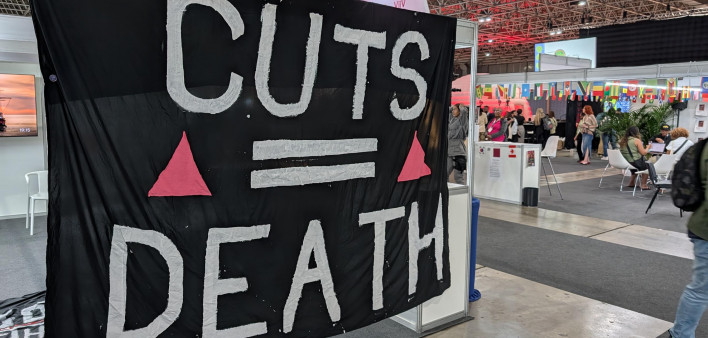
The impact of the severe funding cuts by the United States in 2025 to global health programs is central to the 26th International AIDS Conference (AIDS 2026). The global gathering, hosted by the International AIDS Society (IAS), is taking place in Rio de Janeiro.
The effects of the financial devastation can be seen on the faces of delegates from more than 55 countries who suddenly lost support last year, when the Trump administration made steep cuts to the President’s Emergency Plan for AIDS Relief (PEPFAR) and the United States Agency for International Development (USAID).
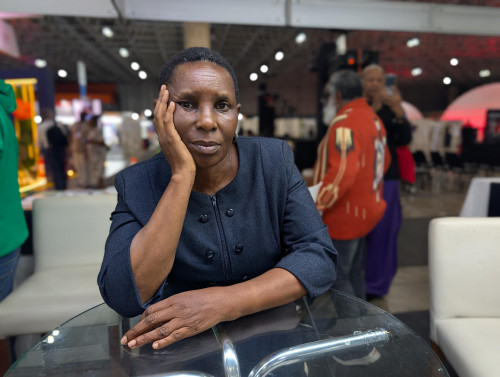
Flavia Kyomukama at AIDS 2026Mark S. King
Flavia Kyomukama, who heads an HIV organization in Uganda, explained it plainly. “This is a breach of trust,” she said, referring to the abrupt disruption of PEPFAR funding, without notice, to hundreds of ongoing prevention and treatment programs.
“They not only cut funding to my organization,” Kyomukama added with emphasis, holding my arm tight to express how personal the issue is to her. “They cut our foundation. They cut our people.”
Kyomukama described her programs as if they were her children. She is proud of them, fiercely protective, and now she is heartbroken. “We provide prevention and treatment education to people, helping them with the stigma that makes them afraid to come to our clinic. And now we must turn them away. Yes. Trust has been broken.”
The impact has had deadly consequences in Uganda, which has an estimated 1.5 million people living with HIV. That number includes many of Kyomukama’s outreach coordinators, who lost their jobs last year for lack of funding. “Since the cuts,” she explained, “many people became depressed when they lost access to medication. In the last year, 20 of my coordinators have died. Not one. Not two. 20. That is just among our staff, people we know. But how many others are disrupted, demoralized or have died without our knowing?”
Kyomukama described a world the United States once knew, where the dying was constant and we struggled to honor the dead while drinking grief from a firehose. The United States may have moved on, ending support for large swaths of the world, but the epidemic across the world is raging again in ways all too familiar to U.S. long-term survivors, like me.
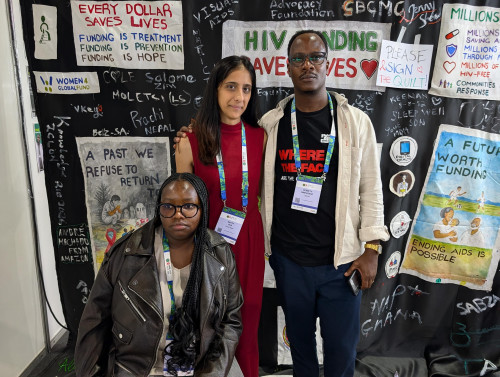
From left: Jerop Limo, Navita Jain and Kenneth Mwehonge at AIDS 2026Mark S. King
Jerop Limo is a young woman from Kenya. She explained that the healthcare system back home, and in countries throughout Africa, can be complicated and intimidating. Community care coordinators help bridge the gap. But no more. Funding cuts crippled all that. “Now,” Limo said, “people are disengaging from healthcare spaces and missing appointments. This is not the system we had, the one that was working.”
Kenneth Mwehonge is executive director of the Coalition for Health Promotion in Uganda. The funding cuts, which came without notice during a contracted grant cycle, meant cutting HIV services and firing community workers. “Already, we are seeing a steep rise in HIV diagnosis, because our drop-in centers and mobile units are gone.”
According to Navita Jain of AVAC, a global HIV advocacy organization, their work on HIV prevention research with a dozen community partners was abruptly halted when funding was halted from USAID. “We were in year eight of a 10-year project, really getting momentum going and accelerating prevention research,” Jain said, “and the cuts had a massive effect, with no guidance provided or a plan for a way forward.”
The sense of unease at AIDS 2026 is palpable, with countless speakers and workshop leaders referring to “the current situation” and “the recent cuts,” as if they were quietly whispering about a scandal in the family. Protests interrupted a main plenary asking for answers. A parade of angry revelers marched through the global village, demanding to know, “Where is the money?”
The United States fared poorly at AIDS 2026. Whatever reputation we once had as a global leader in HIV prevention and treatment is in tatters. It was remarkable how seldom the name of the president of the United States was spoken publicly, as if no one could bring themselves to utter it.
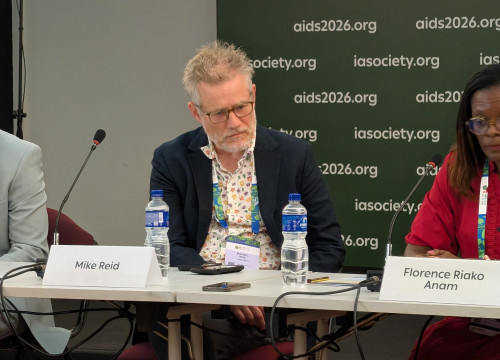
Mike Reid at AIDS 2026Mark S. King
At a roundtable for the press entitled “The Impact of Funding Cuts and What Comes Next,” health leaders from four African nations sat on a panel with Mike Reid, the former chief science officer for PEPFAR. It was the first opportunity journalists had to question someone from PEPFAR, if only a former one.
During the opening remarks from the panel, the same hesitations about naming the cause of the funding cuts held fast. Florence Riako Anam of the Global Network of People Living with HIV (GNP+) spoke broadly about “reestablishing trust.” Mathume Joseph Phaahla, the deputy minister of health of South Africa, expressed his hope to create “new agreements” for future funding, presumably with the United States.
Reid, the former PEPFAR official, sat with a worryingly dejected demeanor throughout the opening remarks. I sympathized with him, a former federal official who worked, as so many federal employes do, to make our country and world a better place. I admired him for showing up to answer questions.
Still, the avoidant and vague language of the panel bothered me. I raised my hand for the press conference microphone.
I introduced myself as a long-term survivor and a contributing writer for POZ magazine. Then I said that, in 30 years coming to this conference, I had never felt self-conscious to be American until AIDS 2026. “We all know,” I said pointedly, “that this destruction, this grief, is a direct result of the Trump administration.” Then I turned to Reid.
“How are you?” I asked him, with genuine concern. There was some nervous laughter among the press, and Reid managed a smile. “So much of the work you devoted your life to has been dismantled,” I continued. “I’m curious about how you are dealing with that, as are so many other policy makers at your level of government.”
Reid took a moment. The vibe in the room had shifted. “The last 18 months have been awful for people who work in this government,” he began. “People who have whole careers [of service] and were callously laid off…from inside PEPFAR, it has been a really horrible experience. People are executing policies that make no public health sense. The essential premise of public health is that you want to serve the underserved. When you pull away from that focus, it ceases to be public health.”
The quietly plaintive sound of Reid’s voice had a familiar ring. It came from the same bell that had been sounding throughout the halls of AIDS 2026. The personal toll on so many delegates at AIDS 2026 extended to officials of our own government, and someone spoke to it. It was a refreshing bit of truth-telling.
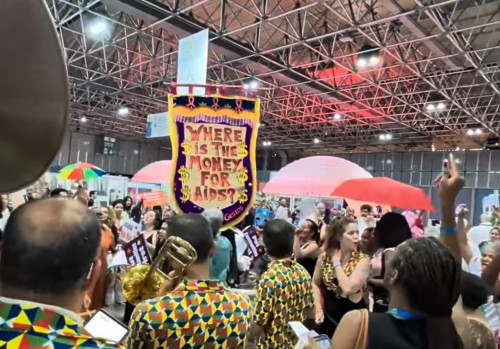
“Where Is the Money for AIDS?” protest at AIDS 2026Mark S. King
AIDS 2026 offered no resolution or clear plan forward. The human pain of funding cuts has been happening throughout the last year and continues.
Before long, the delegates who shared their confusion and grief with me will look past financial concerns. Instead, their time and energy will shift to memorializing all the bodies.
Mark S. King is a long-term survivor, creator of the blog My Fabulous Disease and an award-winning author.
Click here for more news from AIDS 2026.
POZ is an official media partner of AIDS 2026.




1 Comment
1 Comment