

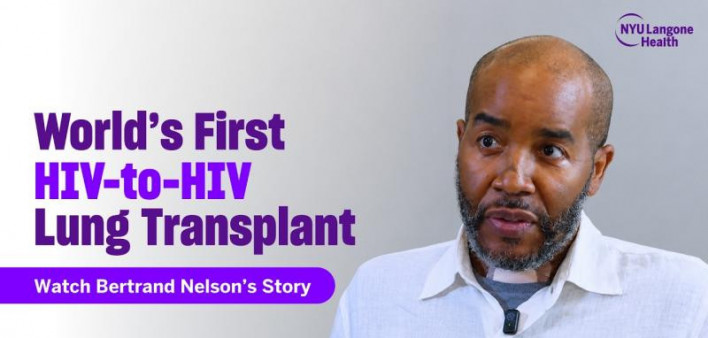
In March, an HIV-positive man named Bertrand Nelson made medical history as the first recipient of a lung transplant from an HIV-positive donor. He also received a new liver from the same donor. This is a result of the HIV Organ Policy Equity Act, or HOPE Act, signed into law by President Barack Obama in 2013 to permit organ donations between HIV-positive persons.
Nelson was diagnosed with HIV in 2000. A bout of Legionnaire’s disease in 2021 ultimately led to his liver and lung failure. POZ caught up with Nelson, currently convalescing with family in New Jersey, for an update on his prognosis and to find out how he’s managing his new lease on life.
Do you think most people living with HIV know that organ donation is a possibility?
I don’t think many know at all. The news of my transplant was also all over social media, and I’ve seen comments there from many people who didn’t know it was possible, commenters were asking “Are people aware of this?” and “How do we get the word out about this?”
And so, people are more aware now who didn’t know [about organ transplants between HIV-positive] prior to my transplant and I’m excited about the word getting out. People living with HIV are now finding out they can be organ donors. And people are even changing their organ donation status because of it.
So how do people living with HIV become organ donors?
Go to registerme.org where anyone can easily update their organ donation status. It’s a very straightforward, quick and easy process. You fill out your name, the last four numbers of your Social Security number, email address, your phone number, hit send and that’s it.
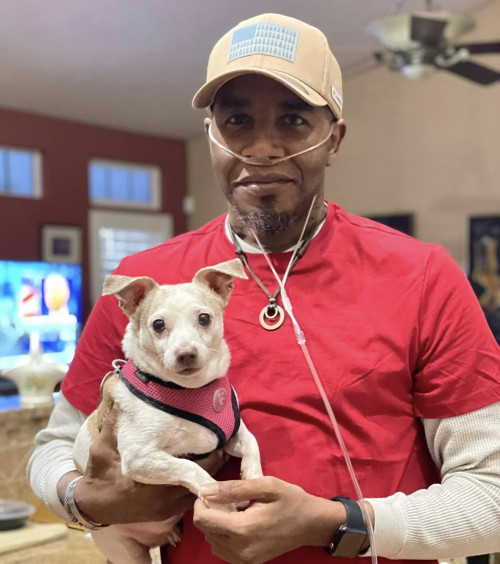
Bertrand Nelson is the first HIV-to-HIV lung transplant recepient. He also had a liver tranplant at the same time.Courtesy of NYU Langone Health/Bertrand Nelson
This is good for people living with HIV, but also for society as a whole because the pool of donors expands.
Exactly! I was part of what they call UNOS, the United Network for Organ Sharing. And then once I was part of the HOPE program, I was on that list as well. So I was on two lists, and the first organ that came up that matched me was HIV positive, and I was able to get that lung. Every person behind [someone on the UNOS list] does move up a notch [each time viable organs from an HIV-positive donor become available].
It’s also great for HIV-positive people in general because, for the longest time, we were deemed unworthy, if you will, and HIV-positive organs were not used because of that. Science has come so far that now they can use these organs, and it’s great for HIV-positive people.
Tell us about the recent changes to the HOPE protocol that led to your lung transplant.
Until recently, the organs that were available [for transplantation between HIV-positive people] were limited to liver and kidney. And it wasn’t until a few months ago that lungs became part of the protocol. Initially when I was listed on October 2 of last year, a lung transplant between HIV-positive persons wasn’t yet possible. It was a few weeks after I was listed that the NYU Langone Transplant Institute [Editor’s note: NYU is the acronym for New York University] called me in and they said, “Hey, are you willing to be part of this new protocol?” And I absolutely said yes. They told me I’d be the first and I thought that was fantastic. I still didn’t realize that I was to be the first lung transplant from an HIV-positive donor in history. I thought I was going to be the first at NYU. So, it was exciting to learn that I was part of that history.
Science has now gotten to a point where you being HIV positive is not a reason for you not to be an organ donor or not to be an organ recipient. You can do that now, and that’s quite an amazing thing.
You mentioned that recovering from your transplant surgery will take about a year. So how are you doing now?
There’s a lot of recovery to do. I’m still weak. But I started physical therapy and my appetite is back.
Is there any way to have contact with the donor’s family?
They usually wait about a year before they introduce you or give any more information to you about the donor. And you also have an opportunity to write a letter to the donor’s family if you choose to and see what the response is. I look forward to the day that I can communicate to them because the gratitude that I have is overwhelming and the sadness that I feel that she [the donor] was so young. At 56, I got the organs of a 23-year-old.
Is there any option for living donations?
There are options for living donors. Someone can give one lung or one kidney as a living donor, and they can give a part of their liver because the liver is the one organ that regenerates. So, if someone gave a portion of their liver, it would grow back to size to fit your body.
President Barack Obama signed the HOPE Act. What would you tell him if you could?
Thank you for making the decisions you did and not letting Congress sway you from what you felt in your heart was right for those of us who are HIV positive. You have saved lives. You have given individuals who are HIV positive the possibility of removing the stigma so that society will have to accept us as full human beings who are worthy just as everyone else.
What are you most looking forward to as you reclaim your vitality this year?
I know once I have my health back, I want to go back to New York City. For me, that’s home. I don’t think my role is to tell people what they should do. I simply hope my story helps people understand what’s possible today. If it encourages organ donation, helps people learn more about the HOPE Act, or gives someone living with HIV hope for the future, then sharing my journey has served its purpose.



Comments
Comments