

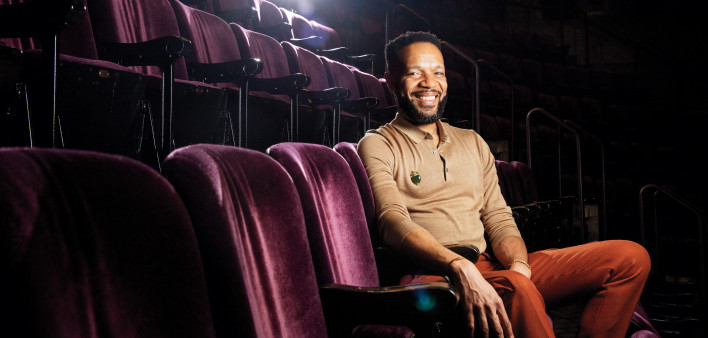
As an actor, Jason Veasey doesn’t usually go off script. But on a balmy, windy evening in November 2024, in front of a couple of dozen people—a mix of friends, colleagues and strangers—gathered at New York’s Michelangelo Hotel, Veasey lowered the barrier between him and the audience. In theater talk, he broke the fourth wall.
The occasion was an event sponsored by Playbill in observance of World AIDS Day honoring the hard work of Tom Viola, the outgoing director of Broadway Cares/Equity Fights AIDS. As part of Playbill’s Storytellers series, Veasey had previously recorded a scripted video in which he discussed the importance of continuing to tell stories about HIV. In the video, he wears a white lace shirt and black pants and sits on a chair in front of a red background.
“While we have a long way to go with releasing stigma and shame and finding a cure for HIV/AIDS, there has been an advancement,” he says in the video, which can be seen on YouTube. “And I find that I know—and you all out there know, or you don’t know that you know—that there are many people living positively with HIV.”
Before recording the video, Veasey had contemplated whether he would seize the opportunity to come out as living with HIV. Though he was not out publicly, many people who love him knew his status—he tested positive January 22, 2015. But when he sat down and began to deliver his monologue, he decided it wasn’t time. “I trusted my gut feeling,” he tells POZ.
When it came time to deliver the same speech to the audience gathered at the Michelangelo that November night, all Veasey had to do was what he had done hundreds, if not thousands, of times before: stick to the libretto. He wore two different earth tones, as if his outfit were a reminder to stay grounded. On his chest, he wore a red ribbon. As he stood up to recite his monologue, something—let’s call it the muse of improv—urged him to go a step further. This time, when he delivered the line about people living with HIV, he appended it with two life-changing words: “There are many people living positively with HIV, like me.”
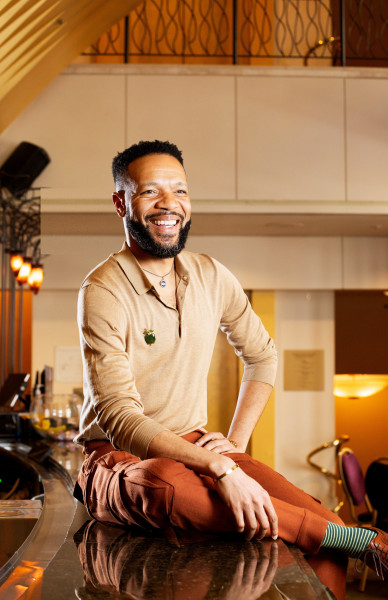
Jason VeaseyAngela DeCenzo
“It just came out,” he says. After his talk, he returned to his seat in the audience, where people were waiting to embrace him. They knew that this was more than a performance—it was a deeply personal step into a new phase of his life. He says, “It felt like the training wheels came off.”
While he may be new to public advocacy, Veasey has been working on an acting career since he was a child. His mother recalls him trying to “get into the box” as a kid, that is, trying to enter the world of the TV. Even then, he was sharply aware that the people on the screen were acting, creators of an artifice he hoped to help create someday.
“I remember thinking, It can’t just be fake—it has to be real,” he says. “I didn’t know what acting was, but I knew it was more than pretending.” Thus, he landed on acting as his dream profession, just as other kids might have picked careers that seemed just as surreal, like astronaut or president.
A self-identified military brat, Veasey moved around often in his youth. He never stayed at one school for long, and his upbringing included time spent living in Colorado, California, Texas, Germany and Alabama.
In the Yellowhammer State, his family resided in Montgomery, which houses both a military base and the Alabama Shakespeare Festival, the state’s official theater. When Veasey joined the local theater, he worked with some of the best in the business on such productions as A Midsummer Night’s Dream as well as non-Bard stage classics, like A Raisin in the Sun and, one of his favorites, Peter Pan.
Veasey has since performed on Broadway and appears in Hulu’s acclaimed hit Only Murders in the Building. Recently, he was the breakout star of the trailer for the new A24 film Friendship. Though the movie centers on the budding friendship between characters played by Tim Robinson and Paul Rudd, Veasey’s velvety voice dominates the teaser. As the action unfolds, Veasey sings the beloved R&B classic “My Boo” by Ghost Town DJ’s. As the trailer went semi-viral, Veasey’s voice—the voice of a person living with HIV—took over the internet.
Internet fame has leaked into real life, he says. The day the trailer hit, his phone started to blow up, and he was even treated to a drive-by serenade while walking down the street in California. “This is about to be my life,” he says. “People are about to be singing that goddamn song to me nonstop. But I’m excited.”
Veasey made his mark on Broadway as an original cast member of the Tony- and Pulitzer Prize–winning musical A Strange Loop. He played one of the five Thoughts—Thought 5, to be exact—before the lauded musical even made it to the Great White Way. He started working on the play in 2012 and was there at one of its earliest live performances in 2015, the year he tested HIV positive, when a ticket to the show was a mere $12. He remained with the production throughout its permutations and has become close friends with the entire team, including creator Michael R. Jackson.
Silence and stigma can be killers for those of us living with HIV.
“It has been one of my greatest honors to be artistic collaborators and, more importantly, friends with Jason for over a decade,” Jackson tells POZ. Jackson added that Veasey shared his HIV status with him very early on in the process of developing A Strange Loop. “I have looked to Jason as a symbol of hope and as a beacon of light and strength. Jason will be a powerful advocate and role model for so many living with HIV. He is a true hero, and I love him.”
Loop depicts the story of Black queer aspiring musical theater writer Usher, who is an usher for Broadway’s The Lion King. The play includes several explicit mentions of the stigma and shame associated with HIV, including a storyline about a friend of Usher’s who died after refusing to take his HIV medication—that narrative culminates in an intense musical number titled “AIDS Is God’s Punishment,” in which the Thoughts sing the title phrase over and over, to an almost numbing effect.
During the number, Veasey perched atop an imposing two-story structure that looms large onstage. Behind him illuminated letters spelled out H-I-V. Friends who came to see the show were concerned that singing these lyrics on a daily basis might affect him personally. What was it like to have to repeat the idea that AIDS is a sign of God’s wrath night after night?
But he has never equated AIDS with God’s wrath. He was not raised in a religious household, and he realized early on in his life with HIV, at a support group for newly diagnosed people, that he didn’t have the same relationship with his status as those in the room who had grown up in the church.
“I couldn’t grasp why I was not having some of those intense feelings,” he says of his time in the group alongside people who had grown up religious. “I never once thought that this was a punishment for me existing as a gay person.” Thus, he never felt dread performing Loop’s AIDS song. In fact, he feels he had the best seat in the house, watching Broadway-goers react to the confrontational number.
Veasey says that because he started working on the show before testing positive for the virus, he never associated his HIV status with the work of mounting the production. Also, he considers his experience to be diametrically opposed to the one depicted in the show. “That number has always been about how silence and stigma can be killers for those of us living with HIV,” he says. By contrast, he considers his own story to be one about what happens when you come out and have the support of loved ones. “That’s how I was able to do the show without feeling emotionally charged.”
Prior to his 2015 diagnosis, Veasey’s relationship with HIV was like that of many queer Black kids who had grown up with AIDS happening around them rather than as a member of the first generation of gay adults who experienced the AIDS crisis. Veasey, 45, was born just a year before the Centers for Disease Control and Prevention first announced the earliest cases. “I’m the safer-sex generation,” he says. “I was never taught about sex without someone saying, ‘Oh, this could kill you. Use a condom.’”
However, when he was diagnosed in 2015 at New York’s Callen-Lorde Community Health Center, where he continues to receive care, he didn’t feel shame. Instead, he went into fact-finding mode, hoping to learn as much as he could. He began to share his status with everyone who needed to know, including loved ones and friends.
The only people he waited to tell were his parents, whom he wanted to tell in person. About three months after his diagnosis, his parents could tell, even over the phone, that something was bothering their son—“They always know,” he says—and they scheduled a visit. He shared his status with his father outside a Jamaican restaurant in the Bronx; a few hours later, he told his mother in their hotel room. His mother excused herself to go to the bathroom and returned moments later. They hugged, and she asked a single question, “What are the next steps?”
“I can imagine the fear or concern that can wash over you when it’s your child,” he says. “But I remember this beautiful moment of a mother being loving and holding her child and wanting to know what to do moving forward.”
Afterward, his parents accompanied him to a doctor’s appointment, where his physician answered their questions about HIV. He explained to them how treatment works, what a viral load is and that their son was in good health.
Most days, Veasey says, his status does not come to his mind. Only when he is forced to deal with the bureaucracy of getting his HIV meds does he really start to feel the weight of his status. Because of the nature of acting work, his health insurance coverage can be erratic, and he often relies on the AIDS Drug Assistance Program to pay for meds. During the last three years, between private health insurance and public assistance, he’s barely gone two months without some red tape coming between him and his medication.
“That’s the only time that I feel really overwhelmed with emotion by the reality that I’m HIV positive,” he says. “I’m kind of like, I can’t believe this is my life right now.”
While dealing with the behind-the-scenes work of living with HIV is sometimes marked by discord, Veasey’s colleagues commend him for his ability to bring harmony and collaboration to his acting work. Michael Cyril Creighton, who plays Veasey’s love interest on Only Murders, describes Veasey as “disarming, joyous, open, confident, funny and kind” and says he knows “he’ll always have my back.”
“He’s a remarkable scene partner,” Creighton says. He noted specifically that Veasey helped assuage his nerves about having to yodel during a scene in the show’s second season. “Jason immediately put me at ease. He made it so easy to fall in love with his character and was my biggest cheerleader.”
As a person with HIV working in media, Veasey is acutely aware of the usual stories about HIV that continue to permeate our collective understanding of the AIDS crisis. “While I love so many of the pieces that are cornerstone, like And the Band Played On or Angels in America, I think we’re good for a while with tragedy, drama and people dying,” he says.
Were he able to wave a magic wand and become the head of a major studio, he has a radical idea: a comedy about AIDS. Though he recognizes the need for dramas about the ongoing crisis, especially about people struggling to access good care or medication, Veasey would green-light a funny show about HIV set in a support group for newly diagnosed people. But he’d upend the idea of a group of people sharing while sitting in a circle.
In his imagination, the show would be a sort of Sex and the City focusing on a group of HIV-positive people for whom HIV is only a small part of their lives. The show would tackle them trying to have a baby, for example, or having relationship drama that’s not about their status. One character would be single and ready to mingle. While HIV would always be present, it would often be subtext.
“Not every episode is about someone taking a pill and crying,” Veasey says, envisioning storylines in which “HIV is just a fraction of someone’s life and not the wholeness of someone’s life—that’s what I would like to see.”




Comments
Comments