

New HIV diagnoses rose by about 1,000 cases nationwide in 2023, according to the latest surveillance report from the Centers for Disease Control and Prevention (CDC). These data, however, do not yet reflect the effects of the Trump administration’s recent funding cuts, and advocates fear numbers will rise further in the future.
“HIV programs play an important role in providing access to life-saving, cost-saving services, while sustaining and accelerating the remarkable progress we have made in controlling HIV,’ the advocacy group PrEP4All said in a statement. “The cuts proposed by the administration will set the HIV response back decades. We urge Congress to stay the course on these successful federal programs for HIV and related prevention, treatment and research.”
Given recent disruptions at the CDC—including staff layoffs and communications blocks—the fate of this year’s national HIV surveillance update was uncertain, but the agency did release some key findings on April 29.
According to the new data, 39,201 people in the United States and its territories were diagnosed with HIV in 2023, up from 37,981 in 2022.
Men accounted for 81% of new HIV diagnoses. Women made up 19% of cases, half of whom were Black. Unlike past reports, there is no mention of transgender people anywhere in the key findings, apparently in keeping with the federal government’s new mandate to root out “gender ideology.” It’s not clear whether cases among trans women were included in the count for “men who have sex with men” or left out entirely.
Over half of newly diagnosed people lived in the South, 38% were Black and more than a third were Latino. Two thirds of the cases were attributed to male-to-male sexual contact. Nearly half (47%) of newly diagnosed gay and bisexual men ages 13 to 24 were Black, while among those ages 24 or older, Latinos accounted for the largest share (40%). Injection drug use was the presumed transmission route for 6% of newly diagnosed people, with white people accounting for the highest proportion (44%).
The national HIV diagnosis rate was 13.7 per 100,000 people aged 13 and older, but this rose to 22.5 per 100,000 for men, 31.3 per 100,000 for people in the 25 to 34 age group and 41.9 per 100,000 for Black people.
According to the report, nearly 1,133,000 adolescents and adults were living with diagnosed HIV in 2023. Of these, 77% of were men, 39% were Black, 46% lived in the South and 26% were ages 55 to 64, reflecting the aging of the HIV population.
Some 4,500 adolescents and adults died of HIV-related causes in 2023. More than 40% of those who died were Black, and 56% resided in the South. HIV-related death rates were highest in Washington, DC, Georgia and Florida.
Effect of Budget Cuts
The CDC noted that publication of its full “HIV Surveillance Supplemental Report: Estimated HIV Incidence and Prevalence in the United States, 2019–2023” has been delayed. Incidence refers to all new HIV infections (not just reported diagnoses) and prevalence is all people living with HIV (not only those with a diagnosis). Calculating these estimates is more complex that simply adding up reported diagnosis numbers from the states.
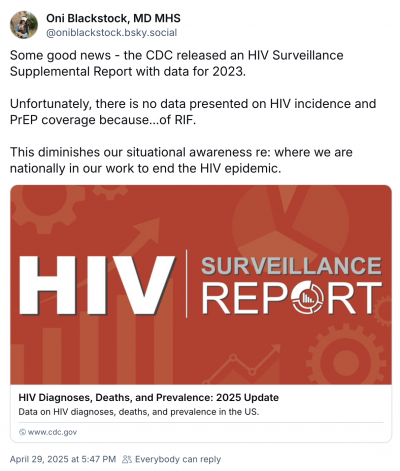
What’s more, this year’s companion report on monitoring selected HIV prevention and care objectives does not include PrEP coverage. In 2024, the CDC paused PrEP reporting for a year to account for newly available data and to determine how best to present this information, but the agency now states that it is unable to resume PrEP coverage reporting at this time due to a reduction in force affecting the Division of HIV Prevention.
“As part of this staffing reduction, the DHP branches that produced HIV incidence estimates and provided the statistical expertise needed to assess PrEP coverage were eliminated,” according to a note accompany the data summary. “CDC is currently evaluating plans and capacity to resume this work.”
Advocates fear that the CDC’s inability to estimate HIV incidence and monitor PrEP coverage is just the tip of the iceberg, as Trump’s “skinny budget” proposal includes deep cuts to HIV programs.
“The drastic cuts to HIV public health and research programs proposed in the president’s budget would leave America’s HIV response in peril if enacted by Congress,” HIV Medical Association chair Colleen Kelley, MD, MPH, said in a statement. “From small towns to big cities, every state across the country may lose lifesaving HIV prevention, testing, and research programs. The result will be more HIV infections nationwide, taking a devastating toll on health and the health care system.”
As summarized by the HIV+Hepatitis Policy Project, domestic HIV care and treatment programs appear to be largely preserved, but HIV prevention is left out. Most treatment-related components of the Ryan White HIV/AIDS Program would remain intact, but it could lose ancillary services such as dental care. AIDS housing programs are slated to take a hit. The fate of the Ending the HIV Epidemic initiative, launched during Trump’s first term, remains unclear. The budget proposal does not include CDC funding for HIV prevention, and it is not yet known whether this will be eliminated or moved to another part of the Department of Health and Human Services. The budget also proposes to cut CDC funding for viral hepatitis, sexually transmitted infections and tuberculosis and shift responsibility to the states.
“We have already seen a dismantling of many domestic HIV programs with staff cuts, grant terminations, and offices shut down, and [the May 2] budget confirms the dangerous direction we are headed in,” said HIV+Hepatitis Policy Project executive director Carl Schmidt. “We look forward to explaining to the Congress the critical federal role in addressing infectious diseases, such as HIV and hepatitis, and the serious implications and consequences to the health of our country if these programs are not adequately supported.”
Click here for more news about federal funding for HIV.



Comments
Comments