

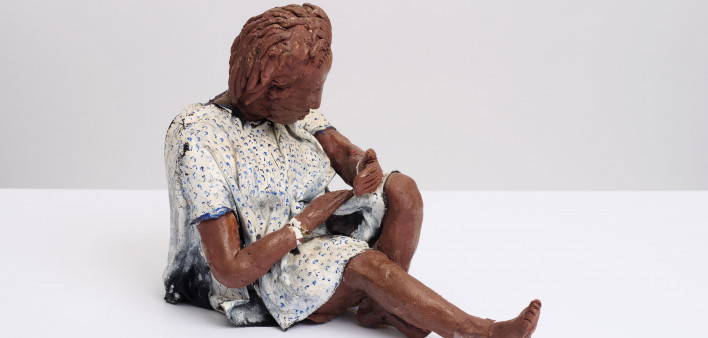
Reverend Joyce McDonald set forth on her path to becoming a sculptor via an art therapy program she participated in after her HIV diagnosis in 1995. Although she grew up surrounded by creativity, her early life was marked by abuse, addiction and loss. After years of struggle, McDonald discovered clay as a medium for healing. The following excerpt is from Kyle Croft’s essay “Crossing the Threshold: Reverend Joyce McDonald’s Art Worlds,” which was included in Ministry: Reverend Joyce McDonald, the catalog for McDonald’s recent exhibition at the Bronx Museum.
Born in 1951, McDonald grew up in Brooklyn’s Farragut Houses at a time when the housing projects represented an image of Black middle-class life. Creativity ran in the family: her father was an accomplished photographer, her mother designed clothes and furnishings, her sister was a celebrated novelist, and as a teenager, McDonald sang at the Apollo Theater in a band called the Primettes. She attended the High School of the Fashion Industries in the late 1960s, but eventually dropped out, moved in with a boyfriend who became abusive, and began to experiment with drugs. She cites her father’s death in 1977 as the point at which she became addicted to heroin. The years that followed were marked by sexual violence and a cycle of abusive relationships, as well as the birth of two daughters. Throughout the 1980s she designed hats and clothes, selling them on street corners in Manhattan to make a living. McDonald’s mother helped her raise her daughters during this period, and she credits her family’s support as essential to her recovery from heroin in 1994.
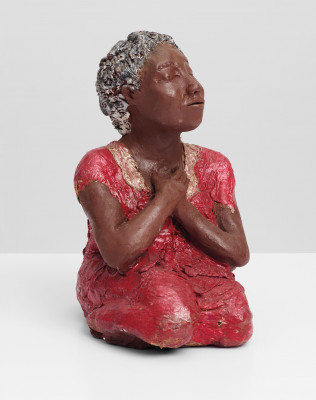
Joyce McDonald’s “Mother’s Prayers,” 1999, acrylic, Mod Podge and paper towel on air-dry clayCourtesy of Ryan Page, Gordon Robichaux, New York, and Maureen Paley, London
The next year, McDonald was diagnosed with HIV and eventually referred to a day treatment program run by the Jewish Board of Family Services. This was one of several such programs in New York City during this era that endeavored to offer comprehensive and integrated services in a community-based, noninstitutional setting for people living with HIV. Located in a basement on Jay Street, near downtown Brooklyn, the program she attended predominantly served clients of color from the nearby neighborhoods of Fort Greene, Crown Heights, and Bedford-Stuyvesant.
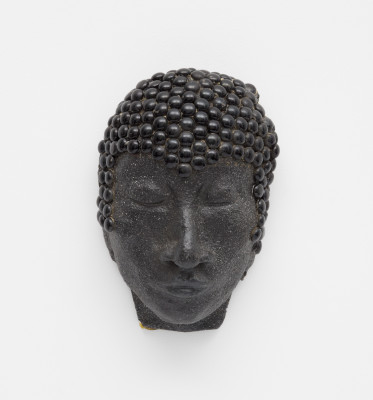
Joyce McDonald’s “Rooted in Strength”, c. 2000, acrylic and glass beads on air-dry clayCourtesy of Ryan Page, Gordon Robichaux, New York, and Maureen Paley, London
When McDonald joined the program around 1997, she met Robert Morrissey, the resident art therapist. Morrissey had been hired to set up an art therapy program a few years prior, eventually establishing a sprawling studio that took over one side of the basement. With ample funding from the Elton John AIDS Foundation and the Ryan White CARE Act, Morrissey “was able to treat everyone in there who was interested as an artist, to provide a place and materials for them to do work every day.” He invited participants to engage freely without an expectation of self-reflection through artistic expression. Sometimes a recurring image would provide a prompt for deeper therapeutic dialogue with a client. More important for Morrissey was the way that artistic practice could facilitate a form of sublimation—a psychoanalytic concept that refers to the transformation of raw, instinctual, or transgressive impulses into culturally valued pursuits.
McDonald was one of about two dozen participants in the art therapy program. It was her first introduction to working with clay. Morrissey recalls:
I put a lump of clay in her hand, as I would do for most folks, and l’d say, “Okay, just squeeze it, move it, shape it, see what it has to tell you, see what emerges.” Clay is very forgiving, you can change it and shape it and reshape it. It also has very visceral properties—it’s squishy, it’s wet, it’s like shit, it’s like body fluids. It has a very deep connection in that way.... Joyce would take the clay and begin to shape and squeeze it...before you knew it, she had impressed upon this rather inert material her story, her family, her struggles, collective struggles. The clay took on a life of its own with her.
McDonald remembers working nonstop, producing dozens of sculptures in her first year in the program. Motifs began to emerge: portraits of women; mothers holding children; families embracing; figures prone and prostrate, in prayer or in pain. This prolific artmaking coincided with—and catalyzed—a period of profound transformation and healing for McDonald.
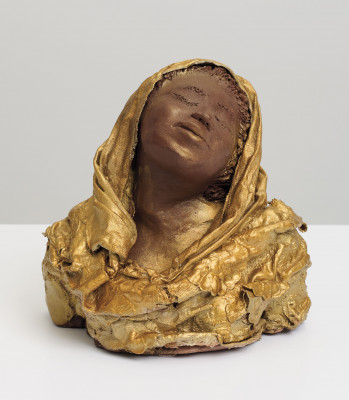
Joyce McDonald’s “Sweet Peace,” 2007, acrylic, Mod Podge and fabric on air-dry clayCourtesy of Ryan Page, Gordon Robichaux, New York, and Maureen Paley, London
Many of the clients Morrissey worked with in the late 1990s were dealing with what he called “Lazarus syndrome”—referencing the biblical figure’s miraculous return to life after being dead for four days. Mortality rates for people living with HIV began dropping steeply after highly effective treatments were approved in 1996; thousands preparing for their impending deaths suddenly found themselves with longer life expectancies. The emotional whiplash of this resurrection was profound—futures once abandoned urgently needed to be reimagined. Salvation and redemption became themes that Morrissey observed across much of the artwork produced at the day program.
For McDonald, a series of explicitly autobiographical pieces stand out from this period, including a group portrait of her family at her father’s funeral, a depiction of a clandestine abortion, and Queen Detox (1998), a self-portrait in a hospital gown illustrating one of her stays in a methadone clinic. Perhaps the most haunting piece in this series is a small sculpture of a fetus titled My Son (1999). Unlike other work from this period, it is roughly formed—the corporeality of clay on full display—and adorned only with a few strokes of gold paint and small indentations to mark his developing eyes.
McDonald called Morrissey after creating that sculpture, crying, “I don’t know what this is, this baby fetus.” Their conversation helped McDonald come to terms with a traumatic period of domestic violence she experienced in her early twenties. “My word came up in clay,” she explains in an interview in this catalog, “that’s how I started seeing it and remembering it and facing it.” Viewed alongside her many depictions of mothers and children, My Son lays bare the emotional weight of this subject matter for McDonald. As she shares in the same interview, her family has been a source of boundless love and acceptance. Yet intimacy and motherhood have also been fraught with loss, shame, and tragedy. Much of McDonald’s work turns on the ambiguous depths of emotion—figures look at once peaceful and pained, both bound and freed.
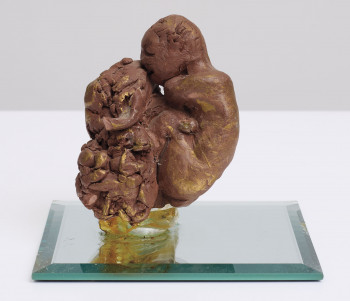
Joyce McDonald’s “My Son,” 1999, air-dry clay and found objectsCourtesy of Ryan Page, Gordon Robichaux, New York, and Maureen Paley, London
Several works across McDonald’s oeuvre illustrate this affective duality through figures with two faces—one looking forward and the other looking back. The 2008 bust From Bondage to Freedom exemplifies this. Viewed from one perspective, it depicts a woman in graceful repose, head tilted to one side and angled slightly upward, eyes closed, eyebrows raised in relief, lips relaxed in a calm smile. The figure on the other side conveys a contrasting affect: her head bowed and lips slightly pursed, she leans forward as if her body is unable to support the burden it carries. Both subjects are clothed, but where the first figure’s dress is neatly draped, the second figure seems confined by the garment, which could also be read as thick cords of rope enveloping her body.
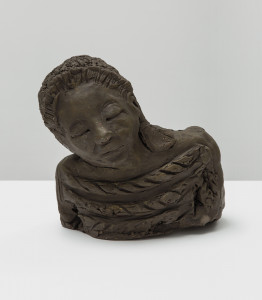
Joyce McDonald’s “From Bondage to Freedom,” 2008, air-dry clayCourtesy of Ryan Page, Gordon Robichaux, New York, and Maureen Paley, London
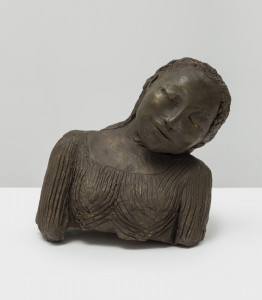
Joyce McDonald’s Joyce McDonald’s “From Bondage to Freedom,” 2008, air-dry clayCourtesy of Ryan Page, Gordon Robichaux, New York, and Maureen Paley, London
The sculpture’s Janus-faced composition suggests the interrelation of these two expressions. McDonald has spoken about the emotional contradictions that kept her silent for so long—how, in an effort to shield both her abusers and her family, she refrained from seeking help. Her response to violence was marked by empathy and a protective instinct. From this perspective, the weight and burden conveyed on one side of the sculpture becomes the cost of the peace and freedom embodied by the other. From Bondage to Freedom also exemplifies how, for McDonald, clay is both an avenue to express what is latent—those past experiences that are difficult to face or put into words—and a way to manifest a different relationship to the body, to project, perhaps, an image of grace. In other words, her material offers access to a sense of agency that had long been denied her.
Kyle Croft is the executive director of Visual AIDS, where he works to preserve the legacies of artists lost to AIDS and to support a global community of artists living with HIV. He is the curator of Ministry: Reverend Joyce McDonald, on view at the Bronx Museum through January 11, 2026.
©️2025. Reprinted with permission from Visual AIDS. All rights reserved. Visit VisualAIDS.org to learn more about the group’s work and McDonald’s art or to purchase a copy of Ministry: Reverend Joyce McDonald.
Reverend Joyce McDonald’s work will be featured in an upcoming exhibtion at Syracuse University. Her third solo show will take place at the Gordon Robichaux gallery in May 2026.




Comments
Comments