

Visual art has played a pivotal role in raising awareness of AIDS since the start of the epidemic. In the 1980s and 1990s, artists such as Keith Haring and Lola Flash and the ACT UP–affiliated collectives fierce pussy and Gran Fury employed distinctive visual styles to broadcast the fact that HIV was killing people and that the government was doing little to stop the spread of the virus.
Just think of the impact Gran Fury’s “Silence = Death” slogan and related art have had over the years. Such powerful messaging helped give rise to health activism as we know it and led to major policy changes regarding the treatment of people living with HIV and AIDS; it also helped fuel the development of new, effective treatment for HIV.
Today, despite having at our disposal the tools to end the epidemic, stigma and lack of access to health care prevent people from getting on medication to prevent HIV and getting tested for the virus—and treated if positive. And once again visual art, particularly public art, is being used—at the local and national level—to raise awareness and effect change.
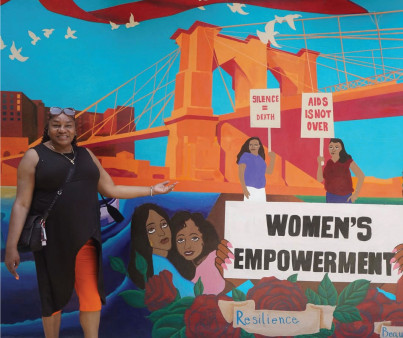
With new HIV diagnoses on the rise in Arizona, the Parsons Center for Health and Wellness in Phoenix, which houses Prisma Community Care, specializing in HIV and sexual health services, unveiled a mural promoting U=U (Undetectable Equals Untransmittable) early last spring. In Montgomery, Alabama, which has the highest number of new HIV diagnoses in the state, the Metropolitan United Methodist Church debuted a mural, late last spring, encouraging folks to get tested for HIV. And in Brooklyn, in August, the Women’s Empowerment Group, a program of Visual AIDS that supports women living with HIV through artmaking and community building, unveiled a mural focused on empowerment and resilience on the facade of a neighborhood pharmacy. The mural was produced in collaboration with Groundswell, which brings together artists, youth and community groups to use art as a tool for social change.
On the national level, on May 17, the ACLU (American Civil Liberties Union) displayed the 9,000-square-foot Freedom to Be quilt composed of 258 panels on the National Mall in Washington, DC. The nonprofit worked for more than a year with hundreds of trans people and their allies across the country to create the quilt. Inspired by the NAMES Project’s AIDS Memorial Quilt, Freedom to Be celebrates trans joy and trans freedom in the face of a hostile presidential administration.
Created by community for community with an eye toward improving public health, such public works of art not only educate and inspire but also beautify the spaces where they’re displayed.

The bold, vivid Parsons Center mural draws the attention of drivers, light rail passengers and pedestrians in downtown Phoenix and features the word love and the phrase “U=U,” which promotes the fact that people with suppressed virus do not transmit HIV.@downtownphoenix and @phxcommalliance/instagram
Send your event photos to POZ at website@poz.com or tag us on Facebook, Instagram or X. For a list of community events, visit poz.com/calendar.





Comments
Comments